REVIEW · RIO DE JANEIRO
Walking Historical Tour
Book on Viator →Operated by Rio in Tours · Bookable on Viator
Rio’s Centro tells stories fast. This 3–4 hour walking historical tour strings together Rio’s cultural powerhouses, from Cinelândia’s theater district vibe to the art and architecture that shaped the city’s identity. It runs in English (plus Italian and Spanish) with a live guide and a mostly indoor/outdoor mix that keeps things moving.
I especially like two things: the free entry at each stop lets you spend money on nothing but your daydreaming and photos, and the guide gets specific—one guide name that shows up in feedback is Luiza De Sordi, credited with thorough, easy-to-follow explanations. Small group size (max 15) also means you’re less likely to feel like a number while the guide threads connections between buildings.
One consideration: you’ll walk in central Rio’s streets and squares for a few solid hours, so plan for heat and rain. The tour is described as requiring good weather, and you don’t get food or drinks included, so bring your own water.
In This Review
- Key highlights at a glance
- Where the tour starts: Cinelândia and Praça Floriano’s big-city energy
- The National Library: from 1808 royal arrival to a UNESCO-scale archive
- Real Gabinete Português de Leitura: a reading room born from exile
- Municipal Theater and the Metropolitan Cathedral: performance and stained glass
- Colombo and Praça do Comércio: Belle Époque elegance and a repurposed city square
- Candelária and Praça Quinze de Novembro: faith, politics, and a view toward Ilha Fiscal
- Price and what $127.42 really buys you in Centro
- Getting the most out of your walk: comfort tips that actually matter
- Should you book this walking historical tour of Rio’s Centro?
- FAQ
- What languages is the tour available in?
- How long is the walking tour?
- Where does the tour start and end?
- Is pickup available?
- What’s included in the price?
- Do the stops require paid admission?
- Is there a mobile ticket?
- How big is the group?
- Is the tour refundable if I cancel?
- Are food and drinks included?
Key highlights at a glance
- Cinelândia as Rio’s theater-and-nightlife crossroads: you start in a square tied to the old movie, music, and entertainment boom
- National Library + Portuguese reading room: you see how empire-era power and immigrant communities shaped culture
- Municipal Theater + Cathedral light show: architecture lovers get both grand style and colored stained glass
- Colombo confectionery: Belle Époque interior details without paying museum-level prices
- Candelária and Praça Quinze de Novembro views: big monuments plus political and religious context, with sightlines toward Ilha Fiscal
- Max 15 people with a professional guide: easier questions, faster pacing, and better focus
Where the tour starts: Cinelândia and Praça Floriano’s big-city energy
You begin at Praça Floriano in Cinelândia, right in the heart of Centro, near major civic and cultural buildings. Look for the square with two metro exits, facing Santo Antonio hill—it’s a convenient landing spot if you’re using public transport.
Cinelândia is more than a pretty starting point. The square sits on land that used to belong to the former Convento da Ajuda (built in the 18th century, demolished in the early 1900s). The “Brazilian Times Square” idea didn’t happen by accident: businessman Francisco Serrador, a Spanish entrepreneur based in Brazil, helped drive the entertainment concentration. Today, the area’s dense cluster of theaters, nightclubs, bars, and restaurants is still the clue that this was planned to be an entertainment magnet.
A good thing about starting here: you get context early. After learning why the neighborhood was shaped the way it was, it’s easier to understand why later stops feel connected—Rio didn’t build its culture randomly. It built it by concentrating influence, institutions, and public spectacle in a few walkable zones.
You can also read our reviews of more walking tours in Rio de Janeiro



The National Library: from 1808 royal arrival to a UNESCO-scale archive
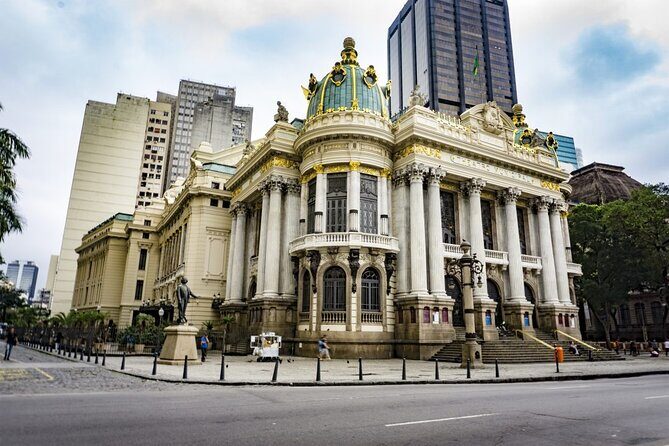
One of the best stops on the route is the National Library of Brazil (Fundação Biblioteca Nacional). This isn’t a quick photo-op. It’s described as a depository for Brazil’s bibliographic and documentary heritage, recognized by UNESCO as one of the ten largest national libraries in the world and the largest in Latin America.
What I like about this stop is the way it ties reading rooms to politics. The collection’s deeper roots trace back to 1808, when the Portuguese royal family arrived in Brazil. Works of art that remained after the royal return helped form the initial core of the collection. Dom João VI also founded the Royal School of Science, Arts and Crafts, which shows how cultural institutions were used as tools of state-building.
Then, the name shifts mirror the country’s own transitions: in 1826, Emperor Pedro I changed it to Academia Imperial de Belas Artes. With the Republic, it became Escola Nacional de Belas Artes. You don’t just learn dates—you see how ideology and governance can rewrite the purpose of a building without changing its address in your mind.
Real Gabinete Português de Leitura: a reading room born from exile
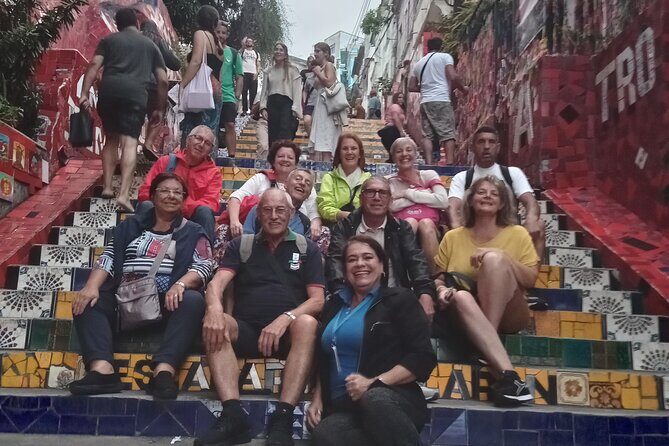
Next you’ll spend time at Real Gabinete Português da Leitura, a cultural institution founded in 1837 by 43 Portuguese immigrants, described as political refugees. That detail matters. This wasn’t only about books. It was about community support, identity, and keeping culture alive in a new capital.
The building is in a style called neomanueline, which evokes exuberant Gothic-renascentist elements tied to Portuguese discoveries. In other words: you’re not just stepping into a quiet library stop—you’re seeing how architecture can act like a cultural flag.
This is the kind of stop that works well if you like atmosphere. Even if your reading level is zero (and you’re not there for reading), you’ll still appreciate the concept: immigrants creating their first association in the city, built around learning and cultural connection.
Municipal Theater and the Metropolitan Cathedral: performance and stained glass
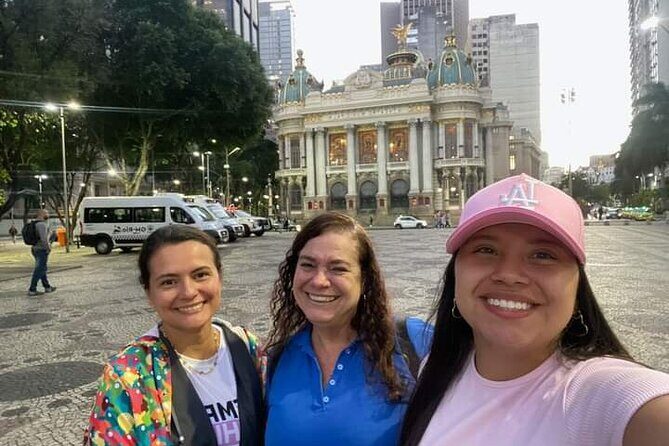
Rio’s cultural institutions get physical here. You visit the Municipal Theater, opened in the early 1900s during one of the city’s major reforms. The design is said to follow the Opera de Paris model, which helps you understand why the theater feels like it was meant to project status and worldliness.
I like that the theater’s role is explained in terms of ongoing use. From the beginning, it played a major part in Rio de Janeiro and national culture—hosting important artists, orchestras, and ballet companies. That means this isn’t only about old stone. It’s about the stage as a continuing platform.
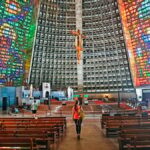
Then you move to Catedral Metropolitana de São Sebastião do Rio de Janeiro, inaugurated in 1979. The building’s conical form is the standout, but the real visual hit comes from the colorful stained glass windows that run up the walls toward the summit. For photo lovers, this stop gives you light and color in a way that’s hard to fake later.
A practical note: cathedral windows and theater interiors tend to reward slower viewing, but the tour schedule still keeps you moving. Wear something comfortable you can stand in for short stretches, and don’t rush the details.
Colombo and Praça do Comércio: Belle Époque elegance and a repurposed city square
After the religious and civic landmarks, the walk takes a delicious turn with Colombo—a confectionery founded in 1894 by Portuguese immigrants Joaquim Borges de Meireles and Manuel José Lebrão.
The idea here is simple: you get a sense of what the Belle Époque felt like, not by reading about it, but by seeing design choices that were meant to impress. The interior renovations in the early 1900s brought an Art Nouveau touch, big crystal mirrors imported from Antwerp, and rosewood wood friezes. There’s even mention of furniture carved by artisan Antônio Borsoi, which adds a human-maker angle to the glamour.
Colombo also expanded with a second floor and a tea room. An opening in the ceiling of the ground floor lets you view the tea room’s skylight decorated with stained glass windows. It’s the kind of detail you could miss without a guide pointing it out—so use the time to look up and not only straight ahead.
From there, the tour shifts to a neoclassical building tied to trade and administration: a former Praça do Comércio complex designed by French architect Grandjean de Montigny, ordered by D. João VI, and inaugurated May 13, 1820. It was created for the First Praça do Comércio in Rio de Janeiro, then later held functions like customs, archives of the Ítalo-Germanic Bank, and even the II Jury Court. By 1990, it opened as a Cultural Center.
This stop is valuable because it shows how buildings can survive by changing jobs. The square’s identity evolved with the city’s needs, but the footprint remained. That’s a big part of why a walking tour works: you’re tracing the city’s “job changes” without needing transportation.
You can also read our reviews of more historical tours in Rio de Janeiro





Candelária and Praça Quinze de Novembro: faith, politics, and a view toward Ilha Fiscal
You’ll finish the cultural arc with strong religious and civic imagery at Candelária. The hermitage was built in 1609 by Portuguese Antônio Martins Palma and Leonor Gonçalves after surviving a storm on the high seas while traveling in a ship named Candelária. They promised Our Lady of Candelária that if they survived, they would build the hermitage.
Construction and upgrades continued over centuries, from the 18th century onward, and the parish church began renovations in 1710. The inauguration happened in 1811 with the church still unfinished, with Prince Regent D. João VI present. It started with one nave, then after interventions by different architects, the dome was finally completed in 1877. The Portuguese limestone dome parts were made in Lisbon, and eight statues on the dome are attributed to Portuguese sculptor José Cesário de Salles. When finished, the dome was described as the tallest building in the city at 62.24 meters from floor to dome, visible from far away.
Then comes Praça Quinze de Novembro, a square with roots stretching to the 16th century. It began with Jesuits building a hermitage facing Piaçaba beach, and the square’s naming tracks national milestones. It was renamed in honor of November 15, 1889, the day the Republic was proclaimed in Brazil. Over time, it held different names and roles: Largo do Terreiro da Polé, Largo do Carmo, Terreiro do Paço, and others.
This stop is also where politics shows up in public art. You’ll see references to figures connected to Brazilian history and later events, including Dom João VI, General Osório, and the Statue of the Black Admiral honoring João Cândido, tied to the Revolt of the Lash in 1910. The square also includes features like the Mestre Valentim Fountain and a view toward Ilha Fiscal.
If you like your history with angles and sightlines, this is your payoff: standing here, you can understand why plazas matter. They’re the stage where power, faith, memory, and everyday life overlap.
Price and what $127.42 really buys you in Centro
The price is $127.42 per person, and the value comes from what’s included versus what isn’t.
Included: you get a professional guide, and the stop entries listed are marked as ticket free, which helps keep costs predictable. The tour also uses a mobile ticket, and languages are offered beyond English, including Italian and Spanish.
Not included: there’s no food or drinks, and no drop-off. That matters because a walking tour can easily turn into snack hunting. Plan to bring water and something small if you’re the type who gets hungry during long museum-adjacent walks.
You’re also paying for interpretation. The guide’s job is to connect the dots: why Cinelândia rose, how imperial-era decisions shaped institutions, and how Portuguese communities left architectural fingerprints. That kind of context is what makes free sights feel like more than random buildings.
Last, the tour caps group size at 15 travelers. In a dense area like Centro, that small number usually means a smoother pacing and fewer lost people when you’re moving between squares and entrances.
Getting the most out of your walk: comfort tips that actually matter
This tour is described as smart casual, and that’s a good guideline. Still, the bigger issue is comfort: you’ll be on your feet for a few hours, switching between open squares and landmark areas.
Here’s what I’d do to avoid a miserable day:
- Wear comfortable walking shoes you trust on uneven pavement.
- Bring water, since food and drinks aren’t included.
- Use a light layer if the weather is changeable; central Rio can shift quickly.
- Have your camera ready, but also take a moment to slow down in places like the cathedral and Colombo where details reward lingering.
Also keep in mind the tour needs good weather. If rain moves in, the experience may be rescheduled or refunded. So it’s worth checking forecasts the day before and keeping your schedule flexible if you can.
Should you book this walking historical tour of Rio’s Centro?
I think this is a strong choice if you want a concentrated historical and cultural route without paying entrance fees. The combination of free-entry landmarks, small group size, and a guide who communicates clearly (with Luiza De Sordi specifically named in positive feedback) makes it feel practical, not just sightseeing.
Book it if:
- You like architecture and institutions, not only street views
- You want a guided explanation tying together culture, empire-era shifts, and immigrant influence
- You’re comfortable walking for a few hours in central Rio
Skip it (or be cautious) if:
- You hate walking and tight schedules
- Weather can be an issue for you, since the tour requires good conditions
- You’re hoping food is included (it isn’t)
FAQ
What languages is the tour available in?
The tour is offered in English, Italian, and Spanish.
How long is the walking tour?
It lasts about 3 hours (approx.), and it’s also described as an approximately 4 hour tour.
Where does the tour start and end?
It starts in Cinelândia at Praça Floriano (Centro, Rio de Janeiro). It ends in Carioca (Centro, Rio de Janeiro).
Is pickup available?
Yes, pickup is offered. If you don’t choose pickup, the tour ends and begins at Cinelândia.
What’s included in the price?
The tour includes a professional guide.
Do the stops require paid admission?
The stops listed are marked as free admission.
Is there a mobile ticket?
Yes, the tour includes a mobile ticket.
How big is the group?
The experience has a maximum of 15 travelers.
Is the tour refundable if I cancel?
It’s described as non-refundable and cannot be changed. If the tour is canceled due to poor weather, you’re offered a different date or a full refund.
Are food and drinks included?
No. Food and drinks are not included, and there is no drop-off.
If you’d like, tell me your travel dates and what you care about most (theaters, churches, old institutions, or architecture). I can suggest the best time of day to do this route so you catch good light and avoid the worst walking heat.