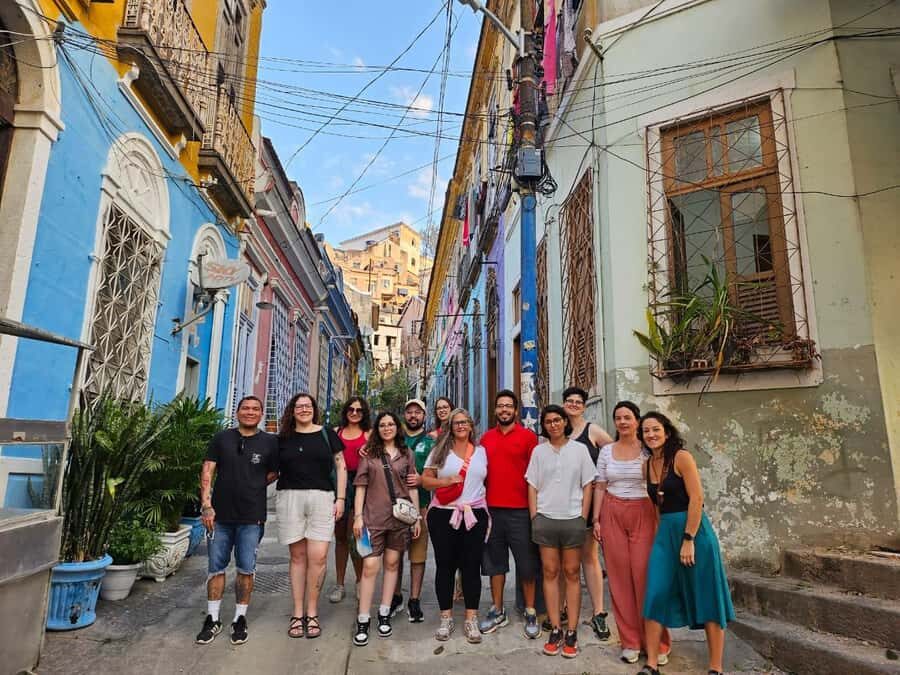
REVIEW · RIO DE JANEIRO
Pedicab Tour of the Historical City Centre in Rio De Janeiro
Book on Viator →Operated by Trio · Bookable on Viator
A pedicab is the easiest way to see downtown Rio. You’ll roll through major landmarks from opera-house grandeur to UNESCO sites, with frequent quick stops so you can get photos and still keep moving. I especially like the relaxed pace and the fact that you don’t bake in the heat like you would on foot.
Two things I really like: the variety of stops (theater, churches, political buildings, waterfront history, street art) and the way the guide works in practical local context so you understand what you’re looking at—not just names and dates. One thing to consider: a few highlights have ticketed admission and you’ll only get quick exterior views at others, like Museu do Amanhã.
In This Review
- Key Highlights You’ll Feel Right Away
- Rio’s Historic Center From a Pedicab: The Value Case
- Price and Tickets: What’s Included and What You’ll Pay Extra
- Getting Oriented at Praça Floriano and the Municipal Theater Start
- Palacio Pedro Ernesto and City Governance in Stone
- Cinelândia’s Amarelinho: A Real Downtown Break
- Lapa’s Arcos: Water Engineering Turned City Icon
- Escadaria Selarón: The Staircase Art World Tour
- Tiradentes Palace: Neoclassical Power With Political Weight
- Paço Imperial: Colonial to Royal to Cultural Hub
- Praca Quinze de Novembro: Arches, Alleys, Market Memories
- CCBB Rio: Art in a Former Bank Building
- Candelária Church: A Colonial-Style Landmark With Republic-Era Meaning
- Museu do Amanhã Exterior: Future Architecture Without the Ticket Rush
- Painel Etnias: A Long Graffiti Mural With a Global Message
- Rio Star and the Giant Wheel: A Quick Waterfront Side Trip
- Cais do Valongo: UNESCO Waterfront History That Hits Hard
- Pedra do Sal: Samba Roots in Saúde
- Morro da Conceição: Colonial Streets and a Strong View
- What the Guide Adds (And Why People Love the Pacing)
- Best Time to Book and Who This Tour Suits
- Should You Book This Pedicab Tour of Rio Centro?
- FAQ
- How long is the pedicab tour?
- Where does the tour start and end?
- Are admission tickets included for every stop?
- Will I be able to visit Museu do Amanhã?
- How big is the group?
- What happens if the weather is bad?
Key Highlights You’ll Feel Right Away
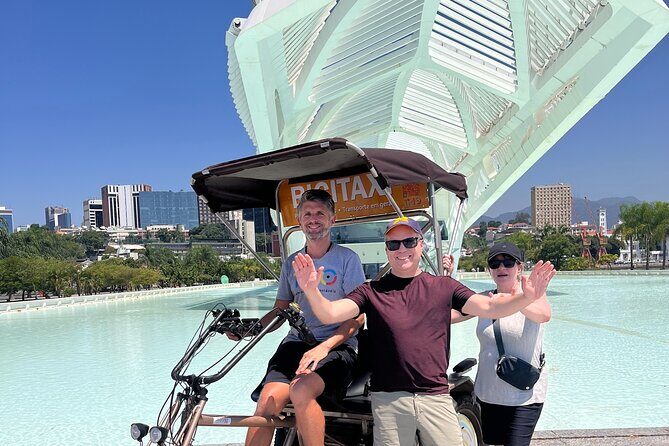
- Short, well-timed stops that keep energy high for 3.5 hours
- Ticket mix: many stops are free, a few need paid entry
- Centro-to-waterfront route with major landmarks in one sweep
- Photo-friendly ride time without long walks between points
- Small group size (max 8) for a more personal experience
Rio’s Historic Center From a Pedicab: The Value Case
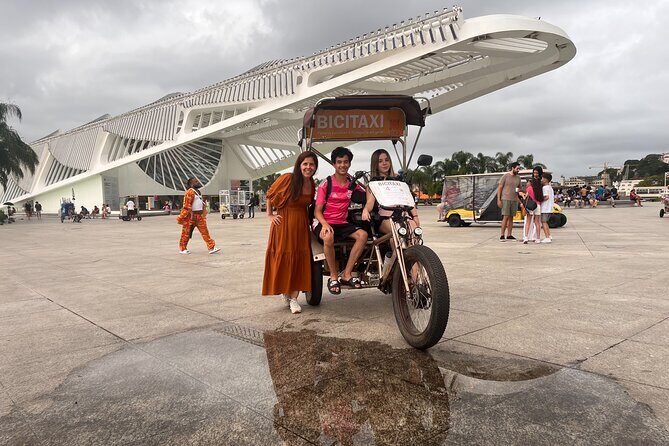
If Rio’s Centro feels like a lot to process, this tour is a smart fix. A pedicab lets you cover ground without turning the day into an endurance test. You’re in motion most of the time, then you hop off for short visits—enough time to look closely, read the vibe, and get your photos without losing the whole afternoon.
At $70.57 per person for about 3 hours 30 minutes, the price makes sense because the tour bundles three things that are hard to combine on your own: route planning, guiding, and timed stops. Many of the major sights you’ll see here are either free or quick to check off; the tour’s real value is the storytelling glue that makes the architecture and history click.
Also, this gets booked ahead. The experience is commonly reserved about 40 days in advance, which is your hint to lock it in early—especially if you’re traveling around busy periods.
You can also read our reviews of more city tours in Rio de Janeiro



Price and Tickets: What’s Included and What You’ll Pay Extra
This tour is built around a mix of free viewing and a few paid entries. For several landmarks, there’s no admission ticket required for the portion you visit. For others, the tour notes that tickets are not included, so you’ll either decide on the spot or plan to skip if you’re trying to keep costs controlled.
Ticketed items (not included) you should expect include:
- Theatro Municipal do Rio de Janeiro
- Palácio Tiradentes
- Museu do Amanhã (you only pass the perimeter, but entry isn’t part of this)
- Rio Star / Giant Wheel area (you can be dropped off to enter)
Everything else on your route is listed as free for the stop itself, which is great for value. The ride also helps you avoid the “we’ll walk, we’ll see, we’ll decide later” problem that drains time quickly in hot weather.
Getting Oriented at Praça Floriano and the Municipal Theater Start

The tour meets at the Municipal Theater of Rio de Janeiro on Praça Floriano (Centro) and ends back at the meeting point. Starting here is a good move. The area sets the tone for the day: civic power, classical façades, and old-downtown symmetry.
Stop 1 is the Theatro Municipal do Rio de Janeiro. Even if you don’t go in, the exterior is a major statement. The tour frames it as a Rio version of grand opera-house style, pointing you toward how Rio wanted to look when it built its first big “first-avenue” stage for culture. You’ll have about 10 minutes, and entry is not included, so if you want interior time you’ll need to plan for tickets.
Palacio Pedro Ernesto and City Governance in Stone
Next you’ll get a fast look at Palácio Pedro Ernesto (the Municipal Chamber building). This one is short—about 5 minutes—but it’s the kind of stop that pays off because it anchors the tour in how the city organized itself in the early 1900s. Expect neoclassical details like grand columns and an interior described as opulent. Admission here is listed as free for your visit.
What I like about this stop is how it changes your brain from tourist mode to “how the city works” mode. You start noticing that Centro isn’t just pretty. It was built to run things.
Cinelândia’s Amarelinho: A Real Downtown Break
Then you’re at Amarelinho da Cinelândia. This stop is only about 5 minutes, and it’s free, but it’s included for a reason: it’s a local gathering point in Cinelândia Square. The tour describes it as an early-20th-century bar and restaurant and highlights traditional Brazilian food and drinks.
You won’t be turning this into a long meal, but you’ll get a chance to sense how downtown life spills out of buildings and into plazas. If you’re hungry, this is a good moment to decide on your next food stop rather than scrambling later.
You can also read our reviews of more historical tours in Rio de Janeiro






Lapa’s Arcos: Water Engineering Turned City Icon
Stop 4 is Arcos da Lapa, also called the Carioca Aqueduct. You’ll have about 5 minutes and it’s free. This is the kind of landmark you can’t really “rush” because the scale hits instantly: 42 arches stretching across over 270 meters.
Here’s the cool part the tour makes clear: it started as a way to move water, then later became part of the city’s transit story when it was repurposed for the tram line. Today, it’s tied to Lapa’s nightlife energy, so even a quick stop feels like you’re standing on a hinge point between older engineering and modern street life.
Escadaria Selarón: The Staircase Art World Tour
Stop 5 is Escadaria Selarón, the famous tiled stairway between Lapa and Santa Teresa. You’ll get about 15 minutes, free, and this is one of those “stop and look again” places.
The tour explains the artist Jorge Selarón’s idea: 2,000+ tiles from more than 60 countries, applied over two decades. Every few tiles is a reminder that this is not a static museum object—it’s an ongoing art conversation. You’ll likely spend the time doing what everyone does here: searching for patterns, photographing friends mid-laugh, and realizing the stairs are basically a public gallery you can walk through.
If you want fewer crowds later, consider taking your photos quickly here and keep moving—your pedicab ride time is part of the fun.
Tiradentes Palace: Neoclassical Power With Political Weight

At Palácio Tiradentes, you’ll have about 5 minutes and the tour notes tickets are not included. The building is described as completed in 1926, originally serving the Chamber of Deputies, and now housing the Legislative Assembly of the State of Rio de Janeiro.
Even without a long visit, you’ll feel the political gravity. Big columns, formal sculptures, and a façade meant to communicate authority. This is a good stop to pause and think about what Rio’s center has always been: government, decisions, and public spectacle.
Paço Imperial: Colonial to Royal to Cultural Hub
Stop 7 is Paço Imperial, a colonial-era building dating back to the 18th century. You’ll have about 5 minutes, free. The tour describes it as starting as the residence for Portuguese governors, then shifting to royal use for Portuguese royals, and later the imperial family of Brazil.
Today it functions as a cultural center for exhibitions and concerts. This stop works because it bridges the city’s layers: the colonial base, the monarchy chapter, and the present-day arts calendar. If you like buildings that show their eras in the details, don’t treat this as a quick glance.
Praca Quinze de Novembro: Arches, Alleys, Market Memories
Stop 8 is Praça Quinze de Novembro, with a short time about 10 minutes, free. The tour plans several micro-visits around the square:
- entering the Telles arch (18th century), which leads into a narrow alley lined with bars and restaurants
- seeing the site of the old municipal market
- getting a viewpoint toward Guanabara Bay and the Fiscal Island palace
This is the kind of area where you’ll feel old Rio’s “commercial streets” energy. You’ll also get a useful sense of geography: where downtown meets the water and how those views shaped where people built and traded.
CCBB Rio: Art in a Former Bank Building
Stop 9 is Centro Cultural Banco do Brasil (CCBB Rio de Janeiro). You’ll spend about 10 minutes, free. The tour notes the building’s age—dating to 1906—and how it’s been turned into an arts center with events like exhibitions, theater, film, and education.
Even if you don’t plan a deep museum hour, CCBB is worth a stop because it’s a classic example of Rio repurposing major civic architecture. You’ll see the façade and feel the “this is a cultural institution now” shift without having to commit to ticketed entry.
Candelária Church: A Colonial-Style Landmark With Republic-Era Meaning
Stop 10 is the Church of Our Lady of the Candelaria (Igreja de Nossa Senhora da Candelária). You’ll have about 10 minutes, free. Construction started in the late 18th century and it finished in the 19th, with a mix of Baroque, Neoclassical, and Renaissance influences.
The interior is described as decorated with paintings, sculptures, and a magnificent altar. The tour also ties the church to major national events, including the Proclamation of the Republic in 1889. That detail matters. You’re not only looking at a church—you’re touching a national turning point.
Museu do Amanhã Exterior: Future Architecture Without the Ticket Rush
Stop 11 is the Museum of Tomorrow (Museu do Amanhã). You won’t go in; you’ll pass the entire perimeter for views and photos. Time is about 20 minutes, and tickets aren’t included.
This is a smart choice for a pedicab tour. It keeps the route flowing while still giving you one of Rio’s most photogenic modern shapes. The tour also notes its striking design and sustainable approach—enough to appreciate the concept without waiting in lines.
Painel Etnias: A Long Graffiti Mural With a Global Message
Stop 12 is Painel Etnias, described as the world’s largest graffiti mural. Time is about 10 minutes, free. You’re looking at a mural painted by Brazilian artist Eduardo Kobra, and the tour gives you the scale: 170 meters long, with faces of indigenous peoples from five continents.
This is where the tour shifts from “architecture and monuments” into “street art as identity.” You’ll get to see how public walls carry culture and debate. The message is about diversity and unity, and it lands fast when you’re standing next to it.
Rio Star and the Giant Wheel: A Quick Waterfront Side Trip
Stop 13 heads toward the end of the Olympic Boulevard for a look at Rio Star (the giant wheel) and the adjacent aquarium. You’ll have about 5 minutes, tickets not included. The tour notes a partnership discount for admission to the Giant Wheel, and you can be dropped off to enter if you want.
This is the place to decide what you care about most: do you want the ride for views, or do you prefer to keep moving and save time for the next historical stops?
Cais do Valongo: UNESCO Waterfront History That Hits Hard
Stop 14 is Cais do Valongo, a UNESCO World Heritage Site since 2017. Time is about 10 minutes, free. This is not a “pretty-photo” stop. The tour describes the wharf as the primary port for the arrival of enslaved Africans in the Americas during the 19th century, discovered during redevelopment in 2011.
You’ll see remnants of the stone wharf and artifacts tied to that period. Even with a short visit, the place asks for reflection. I like that the tour includes it on a route that also has art and glamour, because it stops Rio from becoming a single-tone story.
Pedra do Sal: Samba Roots in Saúde
Stop 15 is Pedra do Sal, in Saúde. About 10 minutes, free. The tour connects it to Afro-Brazilian heritage: historically tied to the salt trade and a gathering place for enslaved Africans and descendants. Today, it’s celebrated as a birthplace connected to samba music and a hub for Afro-Brazilian culture.
This is where the tour becomes about sound and community rather than just stone and tiles. You’ll likely see lively street activity and colorful surroundings. The inclusion is important because it shows how culture grows from survival and community—not from nowhere.
Morro da Conceição: Colonial Streets and a Strong View
Stop 16 is Morro da Conceição, a historic hill with well-preserved colonial architecture, cobblestone lanes, and old churches. Time is about 10 minutes, free.
The tour notes it includes landmarks like Conceição Fort (18th century), and it’s the hill where you can catch panoramic views. It also mentions local creative spaces like art studios and galleries, plus frequent cultural events.
After the tour normally concludes, the route includes a quick corner with three lunch options close together: Italian, Mexican, and traditional Brazilian. This matters because after 3.5 hours, you want food nearby without a long hunt.
What the Guide Adds (And Why People Love the Pacing)
This tour is small, with a maximum of 8 travelers, and that keeps the ride calm. Many people highlight the pacing: you’re not stuck in long lines, and you’re not constantly walking in sweltering conditions. You’ll also get helpful photo moments. One practical win you’ll feel immediately is how the guide helps with timing—quick stops where you need them, longer looks where a landmark demands it.
You might also notice tailoring. The route can adjust based on what you’ve already seen, and some guides (including names like Michael and Carlos from past tours) are known for swapping in extra points of interest. That flexibility is a big part of why this tour performs well as a second Rio visit, not just a first-time checklist.
Best Time to Book and Who This Tour Suits
Book this if you want to maximize a half-day in Centro and along the port-and-waterfront edge, especially if your goal is “see a lot, learn a lot, don’t get crushed by heat.”
This tour tends to fit well for:
- first-timers who want a guided backbone through major sights
- couples and small groups who like photos but dislike sprinting
- families with kids who need shorter bursts instead of long walking
It’s also a good choice if you’re getting in and out of a tight travel schedule, since you’re meeting at a clear landmark and ending back there. The experience is noted as near public transportation, which helps if you’re building the rest of your day on your own.
Should You Book This Pedicab Tour of Rio Centro?
Yes—if you want a fast, humane way to see major landmarks across Centro, Lapa, Santa Teresa-side connections, and the waterfront history area, this is an easy recommendation. The biggest strengths are the efficient route, the short stop structure, and the fact that many highlights are free to view.
Book it particularly if:
- you’re pressed for time and want help building the story of the city
- you don’t want to spend hours walking in humidity
- you value photo stops without long museum-type time commitments
Skip it (or be more selective) if:
- you want long interior time inside every major building, since several stops are designed as quick looks
- you’re budgeting tightly, because a few big-name stops require not-included tickets
FAQ
How long is the pedicab tour?
The tour lasts about 3 hours 30 minutes.
Where does the tour start and end?
It starts at the Municipal Theater of Rio de Janeiro, Praça Floriano, S/N – Centro, Rio de Janeiro – RJ, 20031-050, Brazil. It ends back at the same meeting point.
Are admission tickets included for every stop?
Not all stops include entry. Some stops are listed as free, while a few are marked admission ticket not included, including the Theatro Municipal, Palácio Tiradentes, Museu do Amanhã (you won’t enter), and the Rio Star/Giant Wheel area.
Will I be able to visit Museu do Amanhã?
You won’t enter. The tour states you’ll pass the entire perimeter of the building for views and photos.
How big is the group?
The experience has a maximum size of 8 travelers.
What happens if the weather is bad?
This experience requires good weather. If it’s canceled due to poor weather, you’ll be offered a different date or a full refund.