
REVIEW · RIO DE JANEIRO
Rio in Style: A Journey Thru Corcovado, Sugarloaf, Selaron
Book on Viator →Operated by Guided Tour In Rio · Bookable on Viator
Rio hits hardest when you see it from above. This tour strings together the big-ticket skyline moments—Christ the Redeemer and Sugar Loaf—plus classic neighborhood stops like Ipanema and the colorful Selarón staircase. What makes it work is the pacing and the guide who keeps the group moving, so you spend more time looking and less time guessing.
I love the early schedule for the summit stops, which helps you beat the worst of the crowds. I also like that you’re not stuck in city chaos—there’s air-conditioned minivan transport and return hotel transfers for selected hotels. One thing to plan for: two major attractions require extra tickets, so it’s not a true all-in-one package price.
In This Review
- Key things to know before you go
- Why This Rio Highlights Route Makes Sense
- Morning Start: Copacabana, Ipanema, and the View-Day Energy
- Morro da Urca: First Cable-Car Views (and Why This Stop Matters)
- Sugar Loaf Mountain: The Big “So This Is Rio” Moment
- Ticket reality check
- The Palaces and Streets of Downtown Lapa: Rio’s Layered City Feel
- Selarón Steps: Color, Craft, and a Public Art Story
- Practical note
- Metropolitan Cathedral and Surrounding Landmarks: Modern Shape, Big Atmosphere
- Tijuca Forest to Corcovado: The Ride That Builds Anticipation
- Christ the Redeemer: Early Line Energy and Backup Visibility
- Ticket reality check
- The backup plan I actually respect
- Old Church Stop: Mosteiro de São Bento for a Quiet Pause
- Timing, Crowds, and the Value of a Guide Who Keeps You Moving
- What the guide work really buys you
- What you might find annoying
- Lunch and Break Time: Plan It Like You’re in a Big City
- Is This Tour Worth $97? The Real Value Math
- Who This Tour Fits Best (and Who Should Skip It)
- Should You Book This Rio Highlights Day?
- FAQ
- What time does the tour start?
- Where do I meet for the tour?
- How long is the tour?
- What tickets are not included?
- How much are the Corcovado and Sugar Loaf tickets?
- What happens if Corcovado is obscured by clouds?
- Are there any free stops?
Key things to know before you go
- Small group (up to 14), so the guide can actually keep track of everyone
- Hotel pickup/drop-off (selected hotels) plus a clear start point at Hilton Copacabana
- Backup plan for cloud cover: Mirante Dona Marta replaces Corcovado visibility issues
- Several stops are free, including Selarón Steps and the Metropolitan Cathedral
- Sugar Loaf and Corcovado tickets aren’t included, and you’ll pay for them on site
Why This Rio Highlights Route Makes Sense
Rio is big, spread out, and full of viewpoints that can chew up your day if you try to DIY. This tour is built for the one-day reality: you want the skyline icons, but you also want a sense of neighborhoods, not just photos.
The smartest part is the order. You start early and head toward the major viewpoints before the city thickens with daytrippers. Guides also manage the logistics—where to stand, when to move, and how to keep the group together—so you’re not stuck waiting for stragglers or navigating uphill streets one at a time.
You’ll also get the best kind of “guide value”: not just facts, but timing and problem-solving. If Corcovado is foggy or socked in, the tour swaps to Mirante Dona Marta, which often has better visibility.
You can also read our reviews of more tours and experiences in Rio de Janeiro.



Morning Start: Copacabana, Ipanema, and the View-Day Energy

You begin at 7:00 am, meeting near Hilton Rio de Janeiro Copacabana. From there, you start working your way across the postcard band of Rio beaches—Copacabana into Ipanema—before you climb into the hills.
Ipanema is the star of the early roadside narration here. You pass through the area where wealthy homes line the beachfront, with activity running along the waterline toward Arpoador and Leblon. It’s one of those neighborhoods where you can tell Rio lives outdoors: people walking, stretching, meeting up, and generally treating the beach like a daily room.
If you like your mornings efficient, you’ll appreciate this: the tour doesn’t dump you at one beach and call it “culture.” It uses the drive time to set the scene for what you’ll see later from the mountain tops.
Morro da Urca: First Cable-Car Views (and Why This Stop Matters)

Stop time is short at Morro da Urca, but it’s a useful warm-up. It’s only about 220 meters high, yet it already frames Rio in layers: beaches, the bay, downtown, and the direction of Corcovado.
From the top, you’ll get sweeping sightlines that connect the puzzle pieces:
- Botafogo and Flamengo beaches
- Guanabara Bay
- Rio’s downtown
- the Serra do Mar mountain range
- and, on clear days, Cristo Redentor on Corcovado
This is also where you understand why the city’s viewpoints feel like they’re pointing at each other. Sugar Loaf is next, but Morro da Urca sets the visual logic so the final viewpoints land harder.
Heads up: this stop runs on a schedule, and tickets aren’t included. So when you’re looking up at the cable-car system, don’t assume it’s covered in the tour price.
Sugar Loaf Mountain: The Big “So This Is Rio” Moment
Then comes the payoff: Sugar Loaf (Morro do Pão de Açúcar). The height here is about 396 meters, and the view is the classic wide-angle answer to the question you’ll hear in your head all day: why do people rave about Rio?
You’ll come away with that instant sense of scale—beach curves, bay geometry, and the city stretched toward the mountains. It’s one of those stops where even if you hate heights, you’ll still end up smiling because the view is the whole point.
Ticket reality check
The tour info says the Sugar Loaf admission fee is not included. One review also mentioned a separate cable-car cost issue, so I’d treat this as: you pay there for entry/rides, and you should budget for it. If you’re counting on a single price all day, you’ll want to confirm what your exact ticket includes before you go.






The Palaces and Streets of Downtown Lapa: Rio’s Layered City Feel
Not every Rio highlight has to be a viewpoint. The downtown portion gives you texture.
You’ll pass an old palace building from the mid-1800s that was acquired by the imperial government in the 1860s. It later shifted hands when the Republican government took over, and it underwent restorations and landscape changes. The point isn’t to memorize dates—it’s to see that Rio isn’t only beach and skyline. It has institutions, architecture, and long-term change baked into the streets.
Then the tour leans into Lapa, where you’ll see the Carioca Aqueduct, also known as Arcos da Lapa. Since the late 1800s, this structure has worked as part of the city’s tram connection uphill to Santa Teresa via the streetcar route. It’s a great stop for understanding how Rio moves: not just cars and taxis, but heritage transit and steep neighborhood connections.
If you’re into street scenes and want a break from cameras aimed at the sky, this is where your eyes get to roam horizontally.
Selarón Steps: Color, Craft, and a Public Art Story

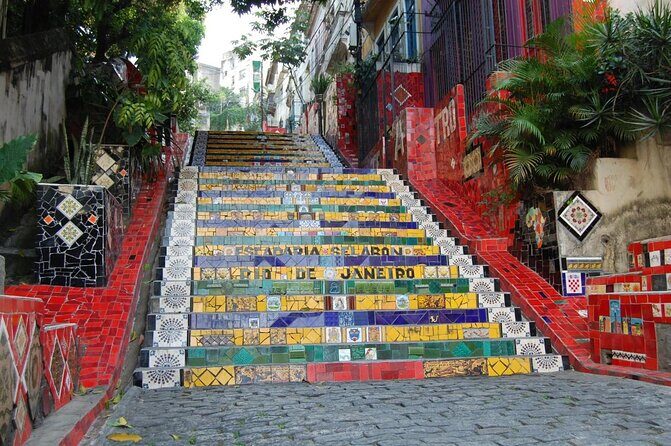
Next is Escadaria Selarón, one of Rio’s most recognizable “walk over there and look closer” places. It’s a staircase covered in tiles—about 215 steps—created by the self-taught Chilean artist Jorge Selarón.
The story is the hook. He moved to Rio in 1983, lived in a small house facing the staircase, and then worked for years collecting tiles from across the city and from visitors. He focused color choices that mirror the Brazilian flag: green, yellow, and blue. The result is part shrine, part mural, part street-level celebration.
This stop is also free, which makes it even easier to love. It’s long enough to soak in details, but you’re not stuck there for hours. And if you’re taking photos, go at a slight angle so you catch the patterns, not just the crowd.
Practical note
Comfort matters here. One review mentioned the staircase can feel tricky if you have balance issues and there isn’t a handrail. If that’s you, take it slow, use the railings where available, and plan to stay near the safer edges.
Metropolitan Cathedral and Surrounding Landmarks: Modern Shape, Big Atmosphere
After Selarón, you’ll visit The Metropolitan Cathedral of Saint Sebastian. It’s a cone-shaped modern landmark, inspired by Mayan pyramid forms, with stained-glass windows that rise floor to ceiling and form a cross at the top.
What surprised me about this kind of stop is how it changes your whole rhythm. You go from the bright chaos of tiles to a structured indoor space with good acoustics—perfect if you like landmarks that feel designed rather than accidental.
This stop is free, so it’s a great one to enjoy without feeling like you’re paying for every minute. If you arrive and the cathedral is closed, it’s not uncommon for hours to vary—one guest reported closure and ticket confusion elsewhere on the route, so keep your expectations flexible.
Tijuca Forest to Corcovado: The Ride That Builds Anticipation
Now you move toward Tijuca Forest, a tropical rainforest area inside the city. You’ll stop at Paineiras to board official park vehicles to reach Corcovado Hill.
This is more than scenery. The ride through the green zone makes the summit feel earned. The air tends to feel cooler than the city streets, and your brain switches from “beach day” to “mountain viewpoint day.”
It’s also where the tour’s design shows. You’re not just dropped at the base and left to figure out the rest. The guide routes the group to the official vehicles, which reduces stress.
Christ the Redeemer: Early Line Energy and Backup Visibility
Finally, Corcovado and Christ the Redeemer. The statue is 38 meters tall, with a mosaic of thousands of triangular soapstone tiles. The visit is about the statue, sure—but it’s also about what the statue frames: Rio’s neighborhoods and bay spreading out beneath you.
The best advice here is simple: go early. Multiple reviews specifically praised the timing for arriving before peak crowds. You’ll likely get more space for photos and less time stuck behind slow-moving lines.
Ticket reality check
This is another stop where admission isn’t included. The tour info lists Corcovado tickets as $20 per person. Plan for it so you’re not stuck negotiating payment midstream.
The backup plan I actually respect
If Corcovado visibility is poor due to clouds, the tour makes an alternative stop at Mirante Dona Marta (free). One guest highlighted that this is meant to help when the summit is obscured, and that’s exactly the kind of “don’t waste the day” planning you want.
Old Church Stop: Mosteiro de São Bento for a Quiet Pause
Next you’ll visit Mosteiro de São Bento, described as the oldest monastery in Rio and known for its Golden Church. This is a calmer counterpoint to the viewpoint circuit—more cultural, less panoramic.
It’s free on the tour. Even if you aren’t a monastery superfan, it’s a good way to break up the adrenaline of mountain stops and tile staircases with something slower and more inward.
Timing, Crowds, and the Value of a Guide Who Keeps You Moving
This is a whistlestop tour, and that can be a good thing if you’re realistic about what a one-day highlight reel can do.
What the guide work really buys you
In reviews, guides like Sabina, Victoria, Monica, Carmen, Ana, Martín, Kiko, Vincent, and Ana (among others) were singled out for staying organized, speaking good English, and handling group movement. That matters because Rio can be a “wait in line, lose your morning” city.
The tour’s structure also aims to minimize dead time between stops. You’re not stuck in transit for long stretches without a payoff. The driver and guide help you re-group and keep the day from feeling chaotic.
What you might find annoying
A few reviews mention ticket confusion or a stop being closed (like the cathedral). Also, some guests expected Sugar Loaf to be fully covered and were surprised about the extra cable-car cost. So I’d treat this as: the tour covers transport, guidance, and many free sights, but key summits require extra payments.
If you hate surprises, confirm ticket inclusions for your specific booking, and bring a credit card plus some cash.
Lunch and Break Time: Plan It Like You’re in a Big City
The tour gives you time to eat and the guide can point you toward restaurant options. The tour info says lunch isn’t included, but reviews include at least one mention of a Brazilian steakhouse lunch, so it sounds like meal inclusion may vary by operator version.
My practical approach: assume lunch is on you unless your exact confirmation says otherwise. Either way, use your break time. The day is long enough that you don’t want to power through on coffee.
Also bring water. One review noted it gets hot fast (41°C), and nothing kills sightseeing like feeling dehydrated and slow.
Is This Tour Worth $97? The Real Value Math
At $97 per person for an 8-hour day with air-conditioned minivan and guided stops, the price is pretty reasonable for what you’re getting—especially because you’re paying for a lot of vertical logistics: mountains, summit access, and multiple neighborhood anchors.
But you do need to look at the total day cost:
- Christ the Redeemer admission is listed as $20 extra.
- Sugar Loaf admission is listed as $35 extra.
- Lunch is not clearly included in the base info, so you should budget for it unless your booking says otherwise.
So yes, you’re paying more at the attractions. Still, compared to DIY planning (tickets, transit time, sorting out access), paying for a guide who handles route and timing can be a good deal. If you’re short on time, this is the kind of tour that turns one day into a clear overview.
Who This Tour Fits Best (and Who Should Skip It)
This tour is best for:
- First-time visitors who want the top Rio landmarks without getting lost
- People who like tight schedules with plenty of payoff
- Anyone who wants help with summit timing, especially around cloud cover
It might not be the best fit for:
- Travelers who hate stairs, crowds, or walking between quick stops
- People who want slow, deep museum-style time (this isn’t that)
- Anyone who needs absolutely all fees included with no on-site payments
If you go with the right expectations—early starts, paid summit tickets, and a packed day—you’ll enjoy the ride.
Should You Book This Rio Highlights Day?
Yes, I’d book it if you want a first-pass overview of Rio and you’re okay paying for the two main summit admissions. The biggest strengths are the early timing, the organized routing, and the backup plan for Corcovado visibility using Mirante Dona Marta.
If you’re the type who gets irritated by ticket surprises, do two things before you go: confirm what your booking includes for Christ and Sugar Loaf, and plan your budget for on-site entrance costs plus lunch.
If you want your Rio day to feel like you hit the highlights without wasting time, this is a solid choice.
FAQ
What time does the tour start?
It starts at 7:00 am.
Where do I meet for the tour?
The meeting point is the Hilton Rio de Janeiro Copacabana, Av. Atlântica, 1020, Copacabana, Rio de Janeiro.
How long is the tour?
It runs about 8 hours.
What tickets are not included?
Entrance tickets to local attractions are not included, including Christ the Redeemer (Corcovado) and Sugar Loaf Mountain.
How much are the Corcovado and Sugar Loaf tickets?
The listed fees are $20 per person for Corcovado (Christ the Redeemer) and $35 per person for Sugar Loaf Mountain.
What happens if Corcovado is obscured by clouds?
The tour makes an alternative stop at Mirante Dona Marta, which is generally less affected by cloudiness.
Are there any free stops?
Yes. The Escadaria Selarón, Metropolitan Cathedral of Saint Sebastian, and Mirante Dona Marta are listed as free, along with the Mosteiro de São Bento.