REVIEW · RIO DE JANEIRO
Rio Historic Center Walking Tour with Typical Brazilian Lunch
Book on Viator →Operated by Good Guide In Rio · Bookable on Viator
That tiled staircase is still calling. This Rio Historic Center walk mixes landmarks with street-level stories. You’ll start in Cinelândia, work your way through Lapa and the churches, then finish back in the center with a included Brazilian lunch.
What I like most is the flow: you’re not stuck staring at one plaque. The tour threads together architecture, religion, and daily life in a way that helps you get your bearings fast. I also really appreciate the small-group feel (max 12 travelers) and the time spent on neighborhoods like Lapa where the city looks like itself.
The main thing to consider is pacing. It’s a 5-hour walk with multiple stops and short visits, so if you want long museum time or deep interior viewing, you may feel slightly rushed.
In This Review
- Key highlights you’ll actually care about
- Cinelândia at 9:00 am: start where Rio shows off
- Selarón’s staircase to Lapa aqueduct: art, graffiti, and a real tram connection
- Inside the Metropolitan Cathedral and up at Largo da Carioca
- Confeitaria Colombo and Praça Quinze de Novembro: old Rio in pedestrian space
- Praça Pio X to São Bento: churches that teach you how Rio layers itself
- Mauá Square, Museum of Tomorrow area, and Eduardo Kobra’s Olympic mural
- Returning to Cinelândia by tram and eating a typical Brazilian lunch
- Price and logistics: what you’re paying for (and what you’re not)
- Who should book this Rio Historic Center walk
- Should you book it?
- FAQ
- What is the duration of the Rio Historic Center walking tour?
- Where does the tour start, and what time does it begin?
- How many people are in the group?
- What are the main stops during the walk?
- Is lunch included?
- Are any entry tickets included?
- Does the tour include a tram ride?
- What if I need to cancel or change my booking?
- FAQ
- What is the price per person?
- Is the meeting point near public transportation?
Key highlights you’ll actually care about
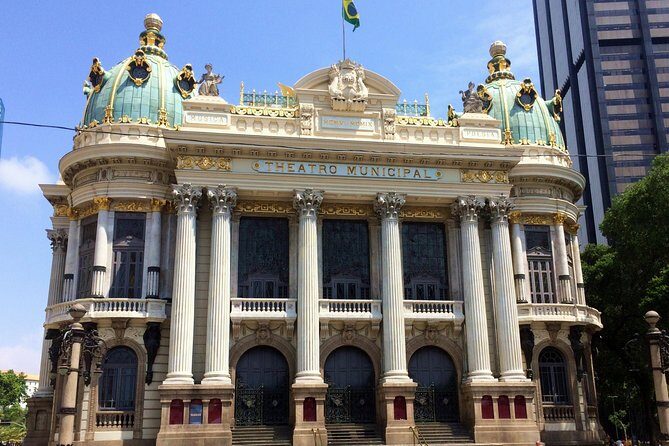
- Cinelândia first: big-square Rio energy at Teatro Municipal and nearby landmarks
- Escadaria Selarón to Arcos da Lapa: art, color, graffiti, and an old aqueduct in one arc
- Church stops with payoff: Cathedral stained glass plus the terrace views at Largo da Carioca
- Old Rio cafés and squares: Confeitaria Colombo and Praça Quinze de Novembro in pedestrian zones
- Street art you can point at: the Estúdio Kobra mural by Eduardo Kobra for the Olympics
- Lunch included at the end: you’re not hunting for food after the walk
Cinelândia at 9:00 am: start where Rio shows off
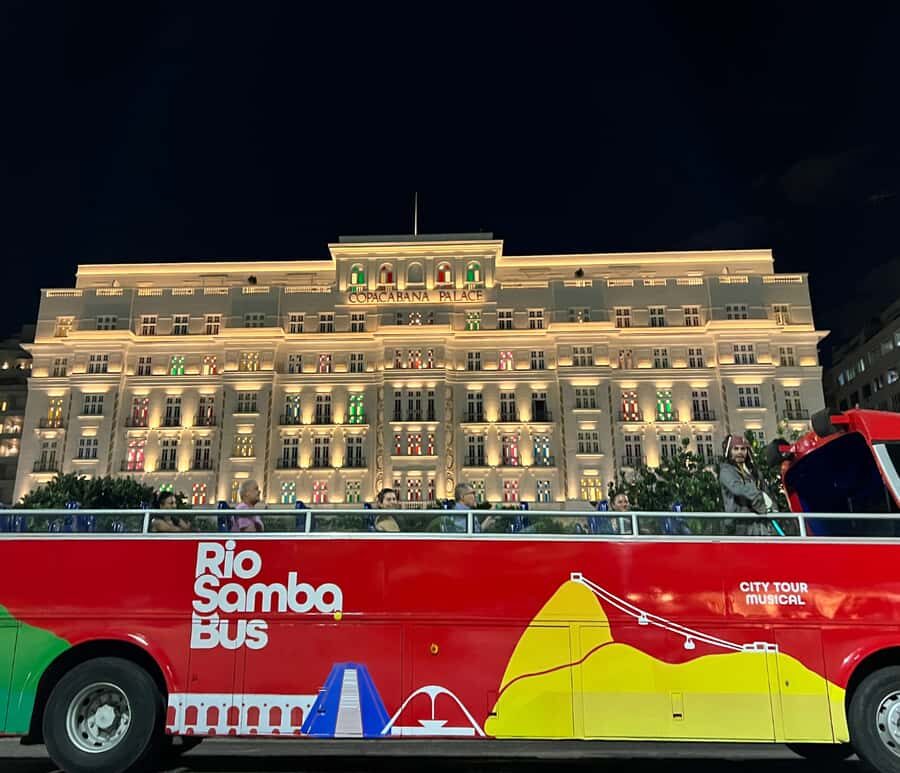
The tour starts at 9:00 am at the Copacabana Palace (A Belmond Hotel). From there, you roll into Rio’s Historic Center with a guide who helps you understand what you’re looking at before you get lost in the scenery.
Your first stop is Cinelandia, a grand square where Rio’s civic and cultural power took center stage. Expect a focused introduction to major sights clustered around the square: the Teatro Municipal (the Rio opera house), the Museu de Bellas Artes, the Câmara Municipal, and the Biblioteca Nacional. You’ll also see Teatro Odeon, which is noted as the only cinema in Cinelandia still operating.
Even if you’re not an opera person, the square is the kind of place that teaches you how Rio wanted to brand itself—formal, monumental, and built to impress. This is also where the guide’s pacing matters. You get just enough context to appreciate the architecture instead of treating the stops like checkboxes.
Time at this first area is about 20 minutes, and it’s a smart opener: you’re warmed up, oriented, and not yet tired.
You can also read our reviews of more walking tours in Rio de Janeiro



Selarón’s staircase to Lapa aqueduct: art, graffiti, and a real tram connection
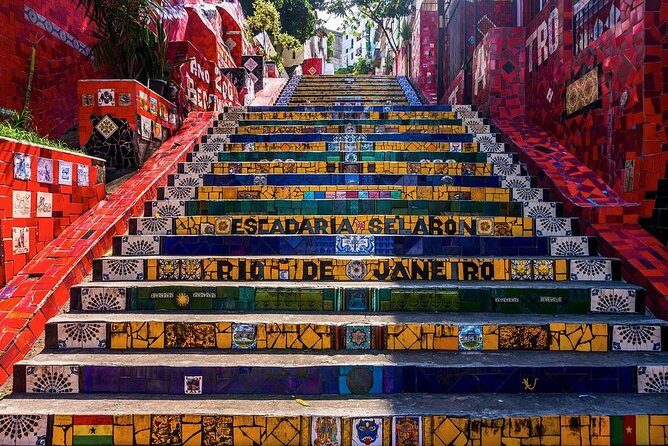
From Cinelandia you move toward Lapa, and the itinerary starts with the iconic Escadaria Selarón. This is the multicolored staircase created by Chilean artist Jorge (George) Selarón, worked on for roughly twenty years. You’ll spend about 30 minutes here, which is the right amount of time to actually absorb it—up close, not just a photo pass.
The staircase sits at the base of the hill near the Santa Teresa side, and the tour’s route matters. You’re learning how these areas connect like a system: hills, neighborhoods, and corridors that locals use. If you’ve ever wondered how Rio neighborhoods link without feeling like they’re on a different planet, this is where it clicks.
Next comes Arcos da Lapa, the old aqueduct from the 18th century that supplied water to Rio until the end of the 19th century. The aqueduct is decorated with graffiti across the district walls, so you’re looking at both historical infrastructure and modern street expression in the same sweep. There’s also a rail/tram connection mentioned in the tour: a tram passes through the aqueduct area to access Santa Teresa.
You get about 20 minutes for this stop. My advice is to take a moment to notice the structure before you jump to the street art. The aqueduct gives the neighborhood its spine; the graffiti gives it its voice.
Inside the Metropolitan Cathedral and up at Largo da Carioca
The walk then turns into a mix of monumental interiors and viewpoints.
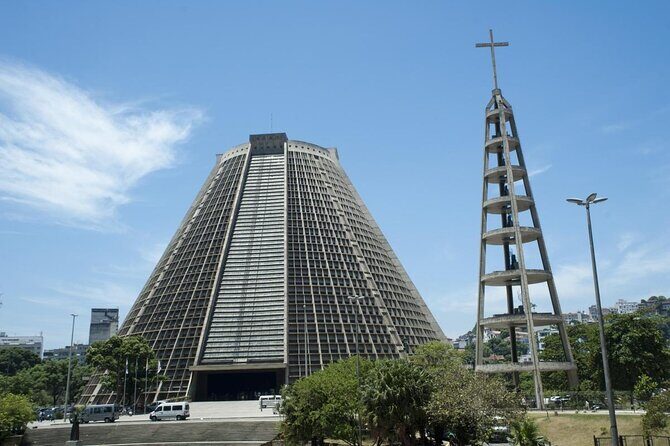
First: the Metropolitan Cathedral of Saint Sebastian. You enter the Cathedral and the guide focuses on architecture, history, and the monumental stained glass windows. The time here is short—about 15 minutes—so the benefit is not endless wandering. It’s a guided explanation that helps you read what you’re seeing quickly.
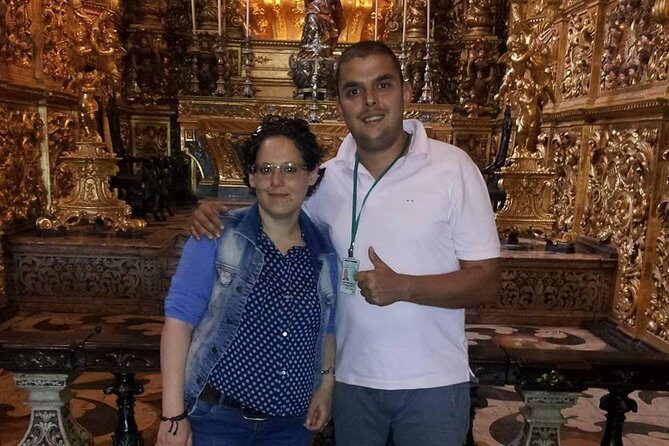
Then you head to Largo da Carioca, with two churches close enough that you can compare them side by side: Sao Antonio church and Sao Francisco da Penitencia. The tour notes the baroque church of Sao Francisco da Penitencia as one of the most beautiful baroque churches in Brazil, and it’s also where the terrace viewpoint becomes a payoff moment.
This stop includes an admission ticket and lasts about 25 minutes. That “included ticket” detail is important. It signals that you’re getting an entry element tied to the best viewing angle, not just walking by for exterior photos.
If you like religious architecture, this is one of the most satisfying blocks of the tour because it combines interior attention (Cathedral) with exterior-and-view payoff (Largo da Carioca terrace).
Confeitaria Colombo and Praça Quinze de Novembro: old Rio in pedestrian space
After the churches, the itinerary keeps you in the pedestrian flow of Old Rio. You reach Confeitaria Colombo, one of Rio’s oldest cafés, with an art deco style that makes it an iconic Centro stop. Your time here is about 10 minutes, and the tour treats it like a cultural marker rather than a long café break.
This is one place where you can decide how you travel: if you want a quick look, you’ll get it. If you’re the type who likes to linger over espresso or people-watching, you’ll likely want extra time after the tour—because the walk moves on.
From there you head to Praça Quinze de Novembro (the 15th of November square, tied to the proclamation of the Republic). In around 20 minutes, you’ll cover a lineup of sights: the Church of Our Lady of the Carmelites, the Paço Imperial, the Equestrian Statue of General Osorio, Tax Island, and the ferry pier for Niterói and Paquetá Island in Guanabara Bay.
This is a great stop for understanding Rio as a working city, not just a photo target. You’ll see the links between civic spaces and the water-bound routes that shape daily life here.
Praça Pio X to São Bento: churches that teach you how Rio layers itself
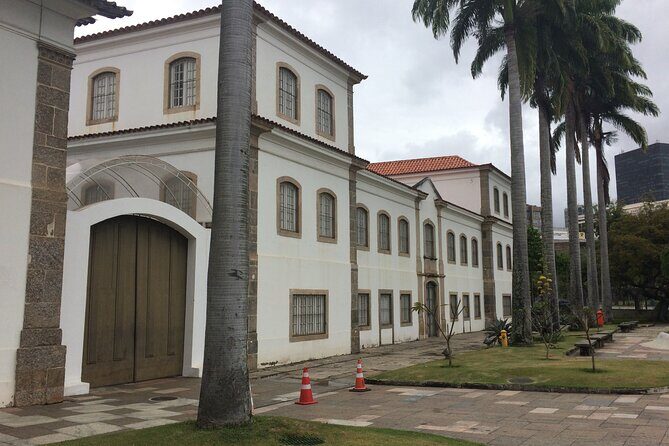
Next you reach Praça Pio X, and the tour uses the space to point out a cluster of cultural and architectural landmarks. You’ll see Cândelaria church, the Olympic boulevard, the CentrO Cultural do Banco do Brasil, and Casa França Brasil. Time is about 15 minutes.
Then comes Mosteiro De Sao Bento (Saint Benoit monastery). This is one of those Rio stops where the guide’s job is especially valuable, because monasteries can look like “just another old church” if you don’t know what to listen for. The tour notes it as one of the most beautiful churches in Rio and focuses on its history as part of the visit. You get about 15 minutes here as well.
What makes this section work is that the tour doesn’t treat every church as the same. It’s pointing you toward differences in style, purpose, and time period—so you begin to see patterns across the city rather than collecting isolated landmarks.
You can also read our reviews of more historical tours in Rio de Janeiro






Mauá Square, Museum of Tomorrow area, and Eduardo Kobra’s Olympic mural

The tour shifts again toward modern Rio—but still connected to what you’ve already seen.
At Mauá Square, you’ll pass by the area tied to the Museu de Amanha (Museum of Tomorrow). The tour specifically says it’s not visited, but it highlights that the architecture is interesting. You’ll also be near the Art Museum of Rio, with a panoramic terrace on the top floor that offers views toward Mauá Square, the Niterói Bridge, and the Museum of Tomorrow area. Your time here is about 20 minutes.
If you’re the type who loves views, this is where you’ll start thinking about how to keep exploring after the walk ends. The tour doesn’t try to sell you a full day of museums—it gives you a strategic taste of what’s around you.
Next is Etnias – Mural de Graffiti (Estúdio Kobra). This mural is described as the largest in the world, representing five ethnic groups, and created by Eduardo Kobra for the Olympic Games. You get about 15 minutes for this stop, and it’s one of the easiest moments to anchor the whole day. It gives Rio’s identity a modern, public-art statement you can point to from across the street.
Returning to Cinelândia by tram and eating a typical Brazilian lunch
Your last major cultural stop is Santo Cristo. After that, the tour mentions taking the tram built by Alsthom for the Olympic Games in front of the Kobra mural to return to Cinelândia square.
This is a nice ending detail because it changes the rhythm. Earlier you’ve been walking and stopping. Here you get a short transit break that still keeps you moving through the neighborhood correctly.
Then you finish back in Cinelandia for lunch with the guide, and this part includes admission. The tour calls it a typical Brazilian lunch, which is the kind of included meal that often makes a guided day feel worth it—you’re not deciding what to eat while your feet are negotiating with your brain.
Price and logistics: what you’re paying for (and what you’re not)
At $126.15 per person for about 5 hours, this tour isn’t a cheap “just walk around” option. But it also isn’t trying to charge you for a stack of museum tickets you’d pay anyway.
Here’s what your money buys:
- Time-saving guidance through a dense historic core
- A route that connects Cinelandia → Selarón → Lapa → major churches → squares → modern mural area
- A small group limit (max 12), which usually means less crowding at viewpoints and inside churches
- A typical lunch included, plus at least one ticketed element (Largo da Carioca)
There’s also a sign of demand: the tour is commonly booked around 61 days in advance on average. That usually means people find it useful for orientation and first-time structure.
The experience provider is listed as Good Guide In Rio, and one French guide name that shows up strongly is Antoine, living in Rio for about eight years and known for knowing the city and its history well. That matters because in a walk like this, the “how” (what you notice and why) is the real product.
Who should book this Rio Historic Center walk
This works especially well if:
- You’re in Rio for a limited number of days and want a guided backbone through the Centro
- You like seeing how history, architecture, and street art connect in the same neighborhood
- You want short, high-impact stops rather than a long museum marathon
It may not be the best fit if you:
- Want long stays inside museums or galleries (the day is structured for multiple stops)
- Prefer purely self-guided exploring where you control every minute
Also, since your base is the Copacabana area and you return to the starting point, it’s convenient if you’re staying in that part of town and don’t want to manage transfers for a half-day plan.
Should you book it?
I’d book this tour if you want a smart, efficient way to understand Rio’s Historic Center without building a day plan from scratch. The mix of Selarón tiles, Lapa aqueduct history, Cathedral stained glass, baroque church terrace views, and Eduardo Kobra’s Olympic mural gives you variety that still feels connected.
Skip it if you already have a lot of time and would rather do museums or neighborhoods on your own with longer interior visits. But if you want your first Centro experience to feel organized and meaningful, this one has the right pace and the added bonus of an included lunch.
FAQ
What is the duration of the Rio Historic Center walking tour?
It lasts about 5 hours.
Where does the tour start, and what time does it begin?
It starts at the Copacabana Palace (A Belmond Hotel) at 9:00 am.
How many people are in the group?
The tour has a maximum of 12 travelers.
What are the main stops during the walk?
Key stops include Cinelândia, Escadaria Selarón, Arcos da Lapa, the Metropolitan Cathedral of Saint Sebastian, Largo da Carioca, Confeitaria Colombo, Praça Quinze de Novembro, Praça Pio X, Mosteiro de São Bento, Mauá Square, the Estúdio Kobra mural, and Santo Cristo.
Is lunch included?
Yes. Lunch with the guide is included at the end of the tour.
Are any entry tickets included?
Yes. Admission is included at Largo da Carioca, and the lunch portion is also marked as included.
Does the tour include a tram ride?
The itinerary includes using a tram built by Alsthom for the Olympic Games to return to Cinelândia after the Kobra mural area.
What if I need to cancel or change my booking?
This experience is non-refundable and cannot be changed for any reason.
FAQ
What is the price per person?
It costs $126.15 per person.
Is the meeting point near public transportation?
Yes, the meeting point is listed as near public transportation.
![[Private Tour] Discover Rio's Tourist Attractions Safely - Corcovado and Christ the Redeemer via Tijuca Forest access](https://tours.riodejaneirotravelguide.com/wp-content/uploads/private-tour-discover-rios-tourist-attractions-safely.jpg)