REVIEW · RIO DE JANEIRO
Historical Rio Walking Tour
Book on Viator →Operated by Carioca Tropical Tour Operator · Bookable on Viator
Rio’s downtown tells its story on foot, and this tour does it with a subway ride and architecture you can actually look at. I love how the guide ties big monuments to everyday life in Rio, not just dates on plaques. The one drawback to flag early: it is not recommended if you have walking difficulties, since this is a steady walking route.
You meet at the Belmond Copacabana Palace entrance at 10:00 am, and then you head downtown with a maximum of 14 people. It runs about 4 hours, and you’ll move through several of the city center’s most important buildings and squares at an easy, guided pace.
This is a good pick when you want more than photo stops. You’ll walk past opera-house grandeur, library scale that surprises people, and government-era palaces, all while getting practical context about how this part of Rio got shaped.
In This Review
- Key highlights that make this tour worth your time
- Walking Rio’s Centro with a guided plan from Copacabana
- From Copacabana to Cinelândia: riding downtown like a carioca
- Municipal Theatre and the 1909 opera-house sparkle
- National Library: the scale you feel when you hear it
- Pedro Ernesto Palace and the Federal Justice Cultural Center
- Tiradentes Palace and Praça XV: politics, law, and street memory
- Paço Imperial: from viceroys to empire to a free cultural center
- Correios Cultural Center, colonial lanes, and a neoclassical turning point
- CCBB cultural center: theaters, library, cinema, and video rooms
- Price and value: is $74.50 a fair deal for 4 hours downtown?
- Who should book this historical Rio walk
- Should you book this historical Rio walking tour?
- FAQ
- How long is the historical Rio walking tour?
- Where do I meet, and what time does it start?
- How many people are in the group?
- What’s included, and what’s not included in the price?
- Do you ride the subway during the tour?
- Is this tour suitable for people with walking difficulties?
- Can I cancel for a full refund?
Key highlights that make this tour worth your time
- Cinelândia’s old subway station: a relic tied to French architectural influence in Brazil
- Municipal Theatre (1909): gilded details, statues, murals, stained glass, sparkling chandeliers
- National Library scale: UNESCO calls it the seventh largest national library in the world and the largest in Latin America
- Praça XV’s layered story: from the Golden Law celebrations to colonial-era street landmarks
- Paço Imperial’s role shifts: viceroys’ residence to imperial seat, then post and telegraph, now a cultural center with free entry
- Small-group attention: guided, not rushed, with time for questions
Walking Rio’s Centro with a guided plan from Copacabana
The tour starts at the entrance of the Belmond Copacabana Palace Hotel in Copacabana, then you take the subway downtown. Meeting at a major landmark like this is helpful because it reduces the usual Centro guessing game, especially if you’re arriving from the beach area.
The route lasts about 4 hours, and the pace is built around walking plus short stops to look and listen. It’s also limited to a small group of up to 14 people, which makes it feel more like a focused city lesson than a cattle-line circuit.
One practical tip I’d follow: wear comfortable shoes. This is downtown sightseeing on foot, and even if the stops are interesting, your legs will still do the work.
You can also read our reviews of more walking tours in Rio de Janeiro



From Copacabana to Cinelândia: riding downtown like a carioca
You’ll begin with a subway ride from Copacabana to downtown, including a stop at Cinelândia Station. That first “ride like locals” element matters more than it sounds. Rio’s city center is spread out in a way that can feel confusing if you’re only using taxis, and the subway helps you understand where the action really sits.
At Cinelândia Station, you’re not just transiting. You’re seeing a piece of Rio’s architectural story from the 1900s, described as a relic of French architectural influence in Brazil. Even if you’re not an architecture nerd, it’s a smart way to get oriented fast.
Right near that station area, the tour also calls attention to a French Renaissance-style building with a collection of paintings by Brazilian contemporary artists plus folk and African art. This is the kind of pairing I love on tours: you get both the building and what it represents, instead of only one or the other.
Municipal Theatre and the 1909 opera-house sparkle
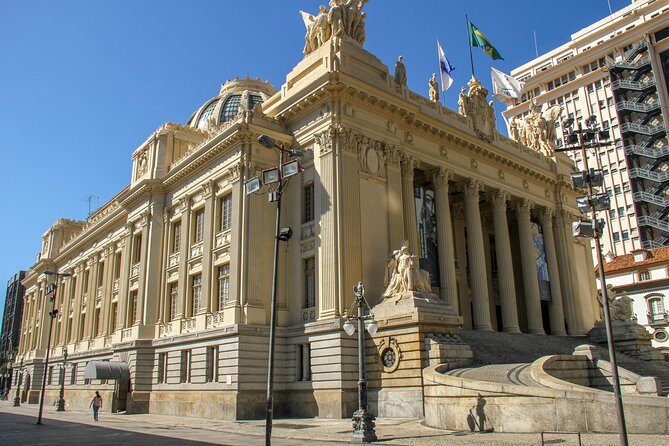
Next comes the Municipal Theatre and city opera house from 1909. This is where the Centro turns theatrical in a very literal sense. The tour focuses on the details—gilded mirrors, statues, murals, stained-glass windows, and sparkling chandeliers—so you’re not just passing by an impressive facade.
Here’s why that works for you: when you’re taught to look at specific features, the building becomes a real experience, not a blur. And Rio’s theater spaces are more than pretty rooms. They reflect how this city wanted to present itself in the era when European styles were strongly influencing design.
If you’re the type who likes to photograph, this is one of your best windows. If you’re not, it’s still worth leaning into the visual descriptions from your guide, because the place only makes full sense when you know what to notice.
National Library: the scale you feel when you hear it
The National Library is the kind of stop that shifts your brain from street-level sightseeing to bigger thinking. You’ll learn that it holds Brazil’s bibliographical and documentary heritage, and it’s recognized by UNESCO as the seventh largest national library in the world and the largest in Latin America.
That’s a lot of ranking language, but the practical takeaway is simpler: this is a serious institution. In a city known for music and theater, it’s a reminder that Rio’s cultural weight also lives in archives, documents, and preservation.
Even though you’re visiting on a walking tour, the guide’s job is to slow your perspective down. Instead of treating the library like a big building you pass, you’ll understand what kind of “memory” it safeguards for the country.
Pedro Ernesto Palace and the Federal Justice Cultural Center
As you move onward, you’ll see the Pedro Ernesto Palace, which now houses the City Council of the municipality. The tour emphasizes it as part of one of Rio’s most valuable architectural ensembles, with a symmetrical main facade rich in details, plus the staircase and upper gallery with double columns and small temple-like elements at the corners.
This is a great stop if you like political history, but it also works for non-history folks. City government buildings teach you how a place organizes power. When you’re walking, those lessons stick because you’re physically moving through the center where decisions were and still are made.
Then you’ll head to the Cultural Center of the Federal Justice. This spot is described as a space that encourages public access to culture through exhibitions, dance and music shows, courses, seminars, and lectures.
I like this pairing because it gives you a contrast. You’re not only seeing power; you’re seeing how culture and civic life try to coexist in the same area.
You can also read our reviews of more historical tours in Rio de Janeiro






Tiradentes Palace and Praça XV: politics, law, and street memory
The Tiradentes Palace is next, and the guide frames it in an especially grounded way. It was the former building of the Brazilian National Congress between 1926 and 1960, and it’s now the seat of the State Legislative Assembly. The exterior details get attention too, including Corinthian columns and an eclectic style.
That combination—power plus design—makes this stop feel real. You’re seeing a building that changed roles over time, which is often what makes cities feel alive instead of frozen in postcards.
From there, you’ll reach Praça XV, a square tied to major transit routes and historic landmarks. It sits between Estação das Barcas for boats to Niterói and other well-known streets like Rua 1º de Março and Arco do Teles, plus it’s near Paço Imperial.
The square’s story includes the fountain of Mestre Valentim, inaugurated in 1789 (though the fountain is deactivated), and the Church of Our Lady of Monte do Carmo. The tour also brings up the Golden Law in 1888, with celebrations tied to Princess Isabel ending slavery in Brazil.
This is one of those moments where a walking tour earns its keep. Without guidance, the square would just look like another central stop. With context, you start to read the street like a timeline.
Paço Imperial: from viceroys to empire to a free cultural center
Paço Imperial is the kind of stop that makes you pause without trying. Built in 1743, it was used as the House of the Viceroys of Brazil. With the entrance of Dom João VI to Rio de Janeiro, it became the seat of the governments of the Kingdom and the Empire.
After the Proclamation of the Republic, the building shifted again, housing the Post and Telegraph. In 1938 it was listed as part of Brazil’s National Historical and Artistic Heritage, and since 1985 it’s been operating as a cultural center linked to the National Historical and Artistic Heritage Institute of the Ministry of Culture, with free entrance all year round.
For your planning, this stop is a strong value moment. You’re seeing a long chain of power and communication in one place, and you don’t need to budget extra for entry.
Also, because it’s free, it’s the kind of spot you might want to linger at if you’re into photos or quiet interior looks. The tour timing will matter, but having free access is always a plus in a city where paid entrances can add up.
Correios Cultural Center, colonial lanes, and a neoclassical turning point
As the walk continues, you’ll reach Centro Cultural Correios. The guide presents it as a “marvelous palace” with Corinthian columns and an eclectic style, tied to how buildings were reused over time in Rio’s center.
The building’s story includes that it was originally planned as a headquarters connected to a Brazilian Lloyd, but that plan didn’t happen. Instead, for more than 50 years the structure supported administrative and operational post functions.
Then came the transformation. It was renovated and reopened in July 2, 1992 for Exposição Ecológica 92, an event linked to the United Nations Conference on Environment Calendar. The official inauguration followed in August of the next year with Filatelia – Brasiliana, 93. Since then, the center has hosted events across areas like theater, video, music, and arts, with an emphasis on integrating cariocas through multiple forms of expression.
Right after the palace, you’ll take a detour into one of Rio’s most atmospheric street experiences: the alleys of Travessa do Comércio near Praça XV. This is described as closed to car traffic and as one of the few areas that preserves colonial traits. If you want a break from big building facades, these side lanes help you feel the old city texture.
The tour then highlights an important work commissioned in 1819 by King João VI to Grandjean de Montigny, connected to the French Artistic Mission. It’s described as the first record of the neoclassical style in Rio de Janeiro, and it helped push a more cosmopolitan tone for a city known for colonial houses.
It’s a neat point because it shows how style changes can be historical documents in their own right.
CCBB cultural center: theaters, library, cinema, and video rooms
To wrap up the center walk, you’ll visit the CCBB, a cultural center with exhibition rooms plus three theaters, a library, a cinema, and a video room. The tour notes it’s housed in an art deco style building located where Rio’s former financial district once stood.
This stop is valuable because it’s a “how the city uses space now” lesson. You’re not only absorbing what happened in the past. You’re seeing how those central buildings support culture today.
It also helps the day feel complete. After palaces, squares, and heritage sites, ending at a functional cultural hub gives you a sense of momentum instead of a final stop that feels like an endpoint.
Price and value: is $74.50 a fair deal for 4 hours downtown?
At $74.50 per person for about 4 hours, the value depends on what you want out of a city-center day. This price includes a professional guide, and the route covers multiple high-impact stops in a compact area: Municipal Theatre, National Library, government palaces, Praça XV, Paço Imperial, cultural centers, and colonial side streets, plus a subway ride.
What’s not included is also clear: food and drinks are on you. There’s no hotel pickup or drop-off, so you’ll be responsible for getting to the meeting point in Copacabana. If you’re already comfortable using the subway, that’s less of a hassle and can even make the tour feel more “local.”
Is it worth it if you’re the independent type? You might be tempted to map everything yourself. But for Rio Centro, the guide’s job is crucial: explaining why these buildings mattered, what to look for, and how the pieces connect saves you time and prevents your visit from becoming a list of photos.
One more value signal: this tour is commonly booked about 46 days in advance. That doesn’t guarantee anything, but it does suggest demand, and it can help you justify booking sooner rather than later if your dates are fixed.
Who should book this historical Rio walk
This tour is a great match if you want a structured, guided walk through Rio’s Centro that covers the big public landmarks without turning into a marathon. If you like city architecture, civic buildings, and squares tied to national moments, you’ll get a lot out of the stop-by-stop explanations.
It’s also ideal if you enjoy asking questions. The tour is small, and the format tends to support back-and-forth, especially when the group is under the cap.
If you have limited mobility or tire quickly, the tour’s walking focus may not suit you. And if you need long breaks or extended indoor time at each stop, you’ll likely feel you’re moving at a guided-tour pace.
Should you book this historical Rio walking tour?
I think you should book it if your goal is to understand Rio’s Centro in a single, well-organized morning/late-morning window. The blend of subway transport, major landmarks, and culturally significant sites like Paço Imperial and the CCBB makes it a strong use of time.
Skip it only if walking is a major challenge for you, or if you strongly prefer self-guided exploration with minimal structure. Otherwise, this is the kind of tour that gives you real context fast, so you can enjoy the city more the moment you step off the route.
FAQ
How long is the historical Rio walking tour?
It runs for about 4 hours (approx.).
Where do I meet, and what time does it start?
You meet at the entrance of the Belmond Copacabana Palace Hotel in Copacabana, at 10:00 am.
How many people are in the group?
The tour has a maximum of 14 travelers.
What’s included, and what’s not included in the price?
The price includes a professional guide. Food and drinks are not included, and there is no hotel pickup or drop-off.
Do you ride the subway during the tour?
Yes. After meeting in Copacabana, you take the subway downtown and stop at Cinelândia Station.
Is this tour suitable for people with walking difficulties?
It is not recommended for people with walking difficulties.
Can I cancel for a full refund?
Yes, you can cancel for a full refund up to 24 hours before the experience start time.