REVIEW · RIO DE JANEIRO
Half-Day Architecture Walking Tour in Rio
Book on Viator →Operated by Rio Carioca Tour Ltda · Bookable on Viator
Rio’s architecture lesson moves at street pace. I love how this walk strings together early colonial Catholic Rio and Brazilian modernism in about four hours, and I love the way the guide turns buildings into stories you can actually picture. One drawback to plan for: two key stops have separate entrance tickets, so your final spend is more than the $60 base price.
You’ll start near Carioca / CentroCentro and end back there, and you can pick between two departure times. It’s a small-group style tour with lots of short stops—perfect if you want good orientation plus real design context without spending your whole day in transit.
In This Review
- Key things to know before you go
- Rio’s downtown-to-modernism route in one half day
- Largo da Carioca: starting where Rio’s story began
- Convent of St. Anthony (Convento do Santo Antonio): 1608 and the lived-in feel
- Cinelândia: Art Deco details, but expect a style mix
- Palácio Capanema: where Le Corbusier’s ideas show up in Brazil
- Edifício Austregésilo de Athayde: a modernist symbol in the center
- Museu de Arte Moderna do Rio: brutalism in museum form
- Price and value: $60 buys the guide, not all the doors
- Getting the most out of the walk (without slowing everyone down)
- Who this half-day architecture tour is for
- Should you book this Rio architecture walking tour?
- FAQ
- How long is the Half-Day Architecture Walking Tour in Rio?
- Where is the meeting point, and where does the tour end?
- How much does the tour cost?
- What’s included in the price?
- Are entrance fees included for every stop?
- Can I attend mass at the Convent of St. Anthony?
- How big are the groups?
- Is the tour affected by weather?
- Do I need ID, and is the tour for kids?
Key things to know before you go

- Two start times so you can fit the walk into a busy Rio schedule
- Mostly exterior viewing, with a couple of interiors where extra tickets apply
- Small groups with a guide (up to 15 travelers per guide)
- A downtown-to-modernism route that many first-timers miss
- Architecture plus backstory, including how politics and economics shaped what got built
Rio’s downtown-to-modernism route in one half day
This is the kind of tour that helps Rio click. Instead of treating the city as a set of landmarks you sprint between, you move along a timeline you can feel—older religious foundations in the center, then the push into 20th-century design when Rio was reshaping itself.
The route also makes practical sense. You’re walking through the Centro area near public transportation, and you return to the same meeting point at the end. That means you can keep the rest of your day flexible—lunch, beach plans, or a second museum stop—without worrying about getting back to a far-off neighborhood.
Price-wise, the math is straightforward. The $60 covers your guide, the route, and the walking tour structure. You’ll add entrance tickets for the Convento de Santo Antonio and the Museu de Arte Moderna do Rio de Janeiro (amounts listed below). If you’re the type who likes to see inside when possible, this tour offers enough stops that the extra tickets usually feel worth it.
The tour also sets expectations well: it needs good weather, and it’s built for people who can walk comfortably with a few photo pauses and short segments at each location.
You can also read our reviews of more walking tours in Rio de Janeiro



Largo da Carioca: starting where Rio’s story began
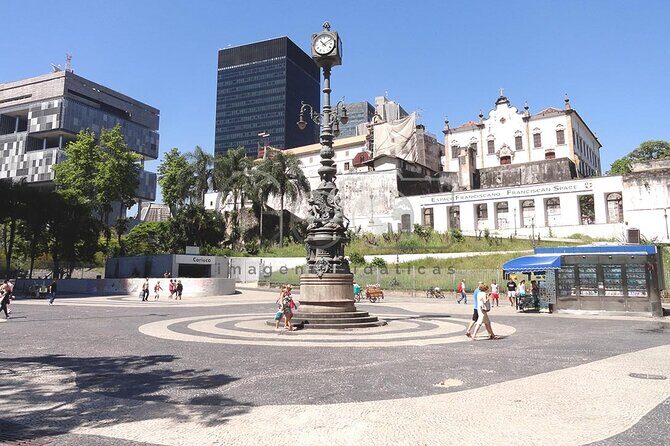
Your first stop is Largo da Carioca, described as the heart of Downtown Rio. It’s the kind of square where history isn’t behind glass—you can look around and sense the city’s gravity from the earliest occupation point.
You spend about one hour here. That’s a good chunk of time for orienting yourself, because this area is the crossroads for much of what happens next. You’ll also get your first visual connection to what you’ll see later: the Church and Convent of Saint Anthony nearby, which matters because the tour’s later stops build directly on this opening chapter.
What I like about Largo da Carioca is that it’s not just “pretty buildings.” It gives you a reference point. Once you understand where the city’s early growth took hold, you start noticing how later architecture behaves—what it imitates, what it rejects, and how planners used space.
If you’re hoping for heavy interior time right away, this isn’t that. This stop is more about setting the stage and taking in the center’s layout before you start paying closer attention to specific styles and institutions.
Convent of St. Anthony (Convento do Santo Antonio): 1608 and the lived-in feel
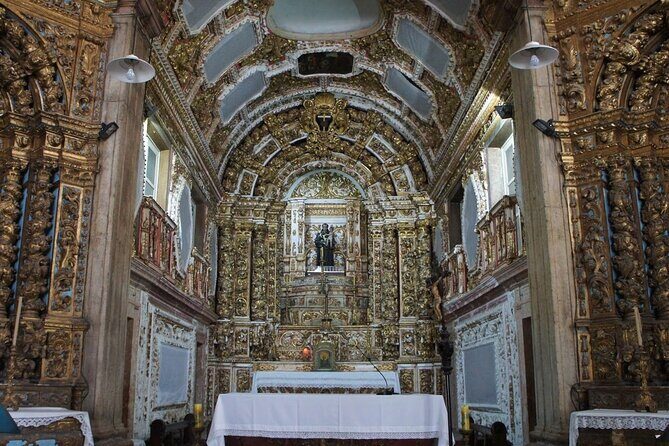
Next is the Convento de Santo Antonio, built in 1608 by the Order of Saint Frances. The tour frames it as one of the first and most important Catholic constructions in Rio—exactly the kind of anchor you want when you’re tracing how a city grows.
Plan for about 30 minutes at this stop. Entrance is 10 BRL per person (not included), and if you’re lucky, you may be able to attend mass. That mass option is a big deal for atmosphere, because it turns architecture into something you experience rather than only observe.
The “why this matters” part is simple: religious complexes in early colonial cities weren’t isolated monuments. They were institutions that helped organize daily life, power, land use, and community rhythms. When you step inside a site like this, you get a clearer sense of how Rio’s center became the engine of the city.
A consideration: mass attendance depends on scheduling. Even if it doesn’t happen, you’re still looking at a landmark that’s old enough to show you how enduring architecture can be.
Cinelândia: Art Deco details, but expect a style mix
Cinelândia is where the tour shifts into 20th-century showmanship. You get about 30 minutes, and the focus is on the area’s Art Deco buildings.
Here’s the reality check: you may find that the buildings’ look leans more toward Beaux-Arts / Belle Époque energy than strict, pure Art Deco at every corner. That’s not a failure of the tour—it’s just useful context. This part of Rio often mixes eras in a single streetscape, and your guide should help you sort what’s what.
This stop is best for people who like façades, proportions, and how a city stages itself. If you’re more interested in interiors and museum artifacts, you’ll still get something here, but it’s shorter and more visual.
One good strategy is to treat this as a “style warm-up.” Use this time to train your eye. Then the tour gets more specific at the modernist stops that follow.
Palácio Capanema: where Le Corbusier’s ideas show up in Brazil
Now you move into one of the most design-forward moments on the route: Palácio Capanema. You’ll spend about 30 minutes, and the key architectural point is that it incorporates Le Corbusier’s Five Points of a New Architecture.
The tour also places the building in a vivid historical snapshot. It was designed between 1935 and 1936 by a team of young architects, including Lucio Costa and Affonso Eduardo Reidy. The icing here is that Oscar Niemeyer, who became Brazil’s best-known architect later, was an intern in Costa’s office at the time.
That “intern” detail matters because it shows how architectural giants are often forged in mentorship and teams—not just in lone genius moments. It also helps you see Brazilian modernism as something studied, discussed, and adapted, rather than something that appeared out of nowhere.
In terms of what you can expect on the ground: this is a viewing stop. You’ll focus on how the building reads in the streetscape, and you’ll likely spend your time comparing the stated design influences with what you see in the structure’s feel and layout.
You can also read our reviews of more tours and experiences in Rio de Janeiro






Edifício Austregésilo de Athayde: a modernist symbol in the center
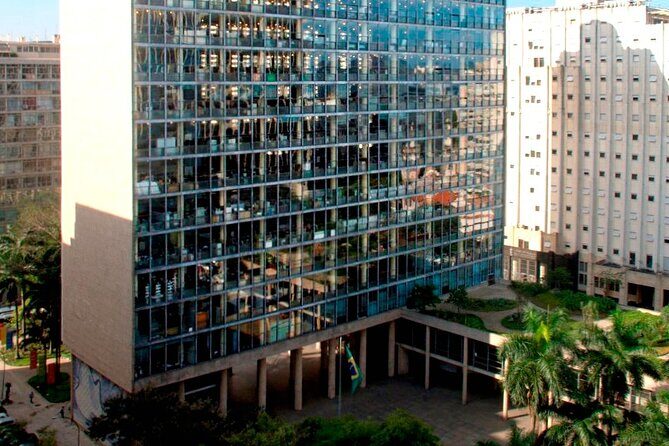
After Capanema, the tour includes a pause connected to Edifício Austregésilo de Athayde. The information you get here is simple but useful: it’s described as a symbol of modernist architecture in Rio, and it’s located inside that building.
Even though the exact time isn’t specified for this stop in the itinerary details, treat it as a quick, design-focused checkpoint. This is the part of the day where you should slow down a little, look for the modernist cues, and let the guide explain what you’re seeing in plain language.
If you’re someone who only understands architecture as “old vs. new,” this is a good moment to shift thinking. Modernism wasn’t one style; it was a set of ideas about function, form, and what a city should do with space in a fast-changing century.
Museu de Arte Moderna do Rio: brutalism in museum form

The final architectural anchor is the Museu de Arte Moderna do Rio de Janeiro (MAM). Expect about 30 minutes, and yes, this one requires an entrance ticket: 20 BRL per person (not included).
The tour describes the museum as inaugurating the brutalism aesthetic in the city. That’s a great line to keep in your head while you’re there, because brutalism isn’t just a look—it’s a mindset about material honesty and bold, structural expression.
If you like the idea of seeing how art institutions use architecture to set mood, this stop is your payoff. It connects design philosophy to a place where you’re meant to look carefully—perfect after a half-day of comparing façades, institutional power, and shifting style eras.
A practical consideration: because this stop is paid-entry, it’s worth wearing shoes you can stand in. You’re not just walking past; you’re spending time inside.
Price and value: $60 buys the guide, not all the doors
At $60 per person, the tour’s value depends on what kind of visitor you are.
Here’s what your money covers: the tour guide and the overall pacing that moves you through several major architectural points without you needing to plan the route yourself. It’s also structured to keep you in one area of town, ending where you started at Carioca / CentroCentro.
Here’s what costs extra: the Convento de Santo Antonio (10 BRL) and the Museu de Arte Moderna (20 BRL). Those entrances can add up, but they also give the tour its real “touch and see” credibility. You’re not just looking; you’re stepping into institutions that shaped Rio’s cultural life.
If you’re thinking, I can do this on my own with a map—maybe. But if you want someone to connect the dots quickly, the guide is the value. The architecture becomes a story instead of a list, and the stops make sense in a way that self-guided wandering often doesn’t.
Getting the most out of the walk (without slowing everyone down)
This is a walking tour, so comfort matters. The tour recommends comfortable clothing and walking shoes, and that’s genuinely the difference between enjoying the day and counting down the minutes.
Also, come with the right mindset. This route doesn’t try to be a checklist of every style in Rio. It’s more targeted: you get one concentrated arc—from downtown origins through modernist landmarks.
Group size is capped at 15 travelers per tour guide, which is a sweet spot for questions and quick explanations while you’re walking. There’s also a broader cap of 100 travelers, so bigger than a private tour, but still designed to feel manageable because you’re split by guide.
If you’re traveling with kids, note that children must be accompanied by an adult, and the experience is described as suitable for most travelers. If you prefer a slower pace, plan to take advantage of photo pauses rather than stopping for long breaks on your own.
Who this half-day architecture tour is for
You’ll enjoy this most if you fall into any of these buckets:
- You like architecture as a way to understand a city, not just as photos for your camera roll
- You want a route that’s heavier on history-and-design context in a short time
- You’re visiting for the first time and want downtown orientation quickly
It’s also a good choice if you like surprises triggered by good guiding. One highlight connected to a church interior in the route is a moment where the guide may encourage close looking—there’s mention of a trompe l’oeil vaulted ceiling and even being invited to lie down for a view of painted perspective. That kind of hands-on attention is exactly why a guide matters here.
Should you book this Rio architecture walking tour?
If you want a fast, smart way to understand Rio’s design story—colonial foundations, then modernism—this is a strong pick. The small-group structure helps, the walking route keeps you from feeling trapped in one building, and the paid-entry stops make the tour more than a street photo walk.
Skip it if you’re chasing only interiors, because most stops include exterior viewing and short segments. Also, if you dislike paying extra for entrances, you may feel the cost creep at Convento and MAM.
My rule of thumb: book it if you’re the kind of traveler who notices details and likes a guide translating what you see into why it exists. You’ll get your bearings fast, and you’ll leave with a better sense of how Rio’s center evolved into the modern city you’re standing in today.
FAQ
How long is the Half-Day Architecture Walking Tour in Rio?
The tour runs for about 4 hours.
Where is the meeting point, and where does the tour end?
The tour starts at Carioca / CentroCentro, Rio de Janeiro, and it ends back at the same meeting point.
How much does the tour cost?
The price is $60.00 per person.
What’s included in the price?
The tour guide is included.
Are entrance fees included for every stop?
No. Entrance tickets are not included for the Convento de Santo Antonio (10 BRL) and the Museu de Arte Moderna do Rio de Janeiro (20 BRL). Other stops listed are free.
Can I attend mass at the Convent of St. Anthony?
If you are lucky, you may be able to attend a mass at the Convent of St. Anthony.
How big are the groups?
There is a maximum of 15 travelers per tour guide. The experience also lists a maximum of 100 travelers.
Is the tour affected by weather?
Yes. The tour requires good weather, and if it’s canceled due to poor weather, you’ll be offered a different date or a full refund.
Do I need ID, and is the tour for kids?
If requested, you must present a copy of your ID. Children must be accompanied by an adult.