
REVIEW · RIO DE JANEIRO
Samba Class in Copacabana
Book on Viator →Operated by Rio Samba Dancer · Bookable on Viator
One hour is enough for samba in Copacabana. I like that this class is beginner-friendly and you don’t need a partner, and I also like the high-energy instruction that turns big Rio music feelings into simple steps. The only real drawback is timing: around end-of-year and Carnival, the room can feel crowded, which can make it harder to see the instructor clearly.
You’ll meet at Av. Nossa Sra. de Copacabana, 807 (room 603), and the studio sits on the 6th floor inside a mixed-use office building. It’s easy to slot into a sightseeing day because the activity ends right back at the meeting point, and public transit plus taxis get you close.
In This Review
- Key things to know before you go
- Samba Class in Copacabana: quick, social, and beginner-proof
- Finding the studio: Av. Nossa Sra. de Copacabana 807, room 603
- The 1-hour class: what you’ll actually do
- Instructors like Marcos, Bem Vind, Carla, and Carmen
- Carnival costumes and Brazilian culture: what the daytime class can add
- Shoes, comfort, and what to bring to class
- Solo-friendly social energy (and why it’s great for couples too)
- Price and value: is $35 for an hour worth it?
- Who should book Samba Class in Copacabana?
- Final call: should you book this $35 samba class?
- FAQ
- FAQ
- How long is the Samba Class in Copacabana?
- Do I need a dance partner or prior dance experience?
- What’s included in the price?
- Where is the meeting point?
- Is transportation to and from other places included?
- Can children participate?
- What is the cancellation policy?
Key things to know before you go
- No partner required: You’ll learn solo, rotate in the group, and still feel like you’re part of the action.
- Real instruction, not just vibes: Instructors give step-by-step counts and correct you as needed.
- Social by design: It’s especially good for solo travelers who want to meet people fast.
- Carnival costume option (daytime): If your class runs in the daytime, you may be able to try on a costume.
- Crowding can happen in peak season: Some sessions run tight, so plan for visibility issues.
Samba Class in Copacabana: quick, social, and beginner-proof

If you’re looking for a first taste of Rio that’s not locked to a tour bus schedule, this samba class fits the bill. You’re not studying theory. You’re moving to the rhythm and picking up actual steps in about one hour.
What makes it work is the teaching style. The class is set up so you can jump in even if you’ve never danced before, and you don’t need to bring a partner to keep up. I also love that it’s built for real social energy—perfect if you want to talk with other people without forcing small talk for hours.
The main consideration is comfort with a packed room during busy times. Around end-of-year and Carnival, the space can get crowded, which can affect how clearly you see the instructor and how the timing feels.
You can also read our reviews of more tours and experiences in Rio de Janeiro


Finding the studio: Av. Nossa Sra. de Copacabana 807, room 603
The meeting point is straightforward on paper, but the setting is a little unusual in person. Meet at Av. Nossa Sra. de Copacabana, 807, room 603 in Copacabana. One key detail: the dance space is on the 6th floor of a mixed working office building, and you’ll enter through a doorway on the main road.
To make this painless, do a quick plan before you leave your hotel. Give yourself extra time to locate the entrance and take the elevator (or stairs) up. If you’re the kind of traveler who hates arriving late and searching around, this is one of those experiences where arriving 10 minutes early is worth it.
The 1-hour class: what you’ll actually do
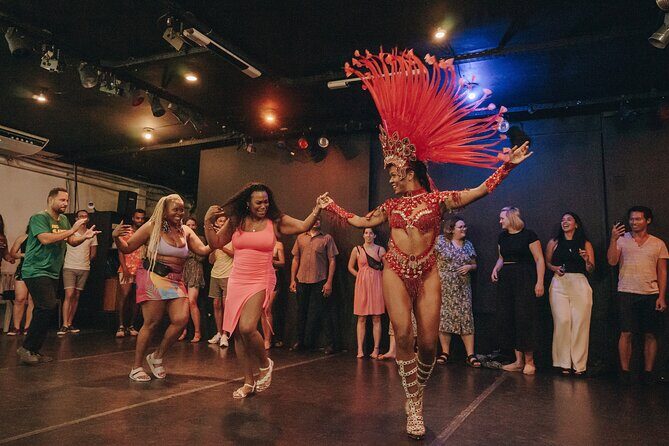
This is a focused, instruction-led lesson. You meet your instructor at the studio and spend the session learning samba basics, practicing steps, and refining them with guidance.
In the best versions of this class, you feel the structure right away. Instructors break steps down with clear counts and cues, then you repeat until your body understands the pattern. You might move across the floor, practice turns, and work forward and backward, all while keeping time with the music.
The teaching approach matters because it prevents the classic beginner problem: you don’t just copy. You learn why the step works. Solo dancers often feel oddly confident by the end, because the instructor adapts to the group’s skill level instead of making you feel behind.
One more practical note: the class is listed as about an hour, but real-world sessions can vary a bit depending on crowd flow. In at least one case, the lesson ran closer to 45 minutes and the space made it feel more efficient than slow and spacious. If you’re time-crunched, that’s usually a bonus.
Instructors like Marcos, Bem Vind, Carla, and Carmen
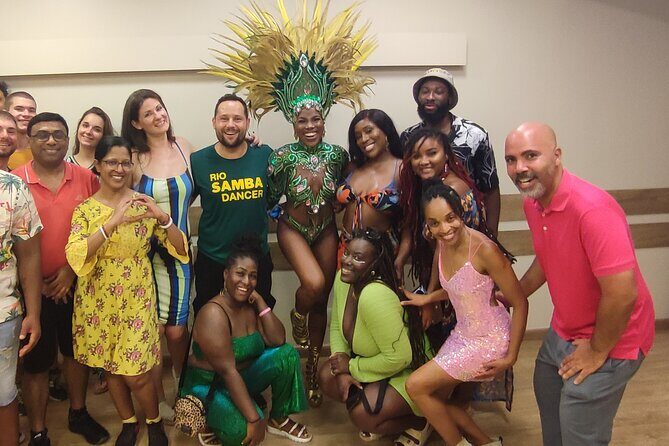
A huge part of the experience is who’s teaching. The class is led by professional instructors, plus you’ll also have a local guide and a tour host/escort working with the group.
From the range of instructor styles, you can expect a consistent goal: make the steps easy to follow and keep the energy up. Some instructors are known for very clear breakdowns and precision, while others lean into humor, big personality, and group interaction. Either way, the common thread is that you don’t get left standing there.
Names you might see mentioned include Marcos, Bem Vind, Carla, and Carmen. If you’re lucky enough to land on a session with one of them, you’ll likely experience instruction that balances technique with fun. For example, one instructor was described as extremely clear with counts, then quickly moving into action once the basic rhythm clicked.
Language can be another factor. The class may be run with a multi-lingual guide, and many instructors can communicate clearly even when English isn’t the main language. Still, if you’re relying on English for every instruction, you should go in with patience. In one experience, the instructor used typed translation during parts of the lesson to help people follow.
Carnival costumes and Brazilian culture: what the daytime class can add
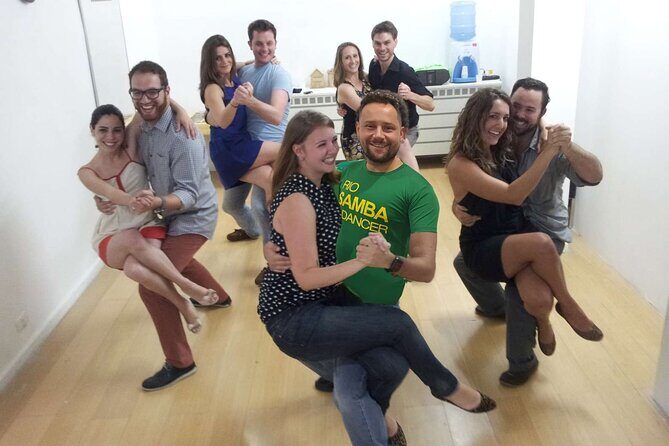
This class has a small but memorable extra: in daytime sessions, you may get a chance to try on a carnival costume. That’s not just for photos. It changes how you move. Costumes tend to cue bigger confidence and more theatrical arm and hip styling, which can help beginners feel more like a samba dancer than someone trying to do homework.
Culture comes up in a simple way, tied to what you’re doing. You don’t need to know samba history to have a good time, but instructors typically explain bits about the rhythm and the meaning behind the style. It’s the kind of context that makes the movement feel connected rather than random.
This is also a nice activity for couples. Even if only one person is really into dancing, the other usually ends up participating because the class is social and structured.






Shoes, comfort, and what to bring to class
Samba is physical, but you’re not going to the gym. You’re learning movement, timing, and coordination, so comfort matters more than looking stylish.
Here’s what I’d plan for based on what’s happened in real classes:
- You might be asked to dance barefoot during some sessions.
- If the studio is crowded, there may be less space to adjust footwear comfortably.
- You’ll want to wear clothes you can move in quickly (no long hemming disasters).
So bring comfortable clothes and a practical mindset. If you hate the idea of going barefoot, you can still show up with your best compromise—comfortable, grippy footwear kept on hand, and then follow the instructor’s lead if barefoot is expected.
Also, you get bottled water as part of the experience, so you don’t need to buy a drink right when you arrive.
Solo-friendly social energy (and why it’s great for couples too)
This is one of those activities that works surprisingly well when you’re traveling alone. The group format helps you blend in fast, because everyone is doing the same beginner steps at the same time. You’re not stuck wondering how to start a conversation—movement gives you the common ground immediately.
Instructors also encourage interaction in a way that feels natural rather than forced. Some sessions are described as making people engage with each other, and that tends to turn strangers into short-term dance partners.
For couples, it’s a low-pressure shared win. You can do it even if one of you is nervous. The lesson environment is structured enough that you’re not watching someone else while you feel left out.
And because it’s only about an hour, there’s less risk you’ll feel trapped if it’s not your thing. You’ll know early if you’re enjoying the rhythm and then you still have time to keep exploring Copacabana after.
Price and value: is $35 for an hour worth it?
At $35 per person for about an hour, you’re not just paying for music and a room. You’re paying for instruction plus support.
What’s included adds real value:
- bottled water
- a local guide
- a professional guide
- a tour host/escort
That matters because it means you’re not trying to figure out timing, steps, or group organization on your own. You get a guided experience in a set studio space, and you can treat the class like an event instead of an improvisation.
Also, the location is a practical win. Copacabana is already full of things to do, so booking a short activity here saves you from the “long commute tax.” The tour notes that transportation to and from attractions isn’t included, which is normal for short studio experiences—but it also means you get to keep your plan flexible.
Compared to longer classes, the short duration is part of the value proposition. If you’re in Rio for a busy week, this gives you a samba intro without hijacking your entire schedule.
Who should book Samba Class in Copacabana?
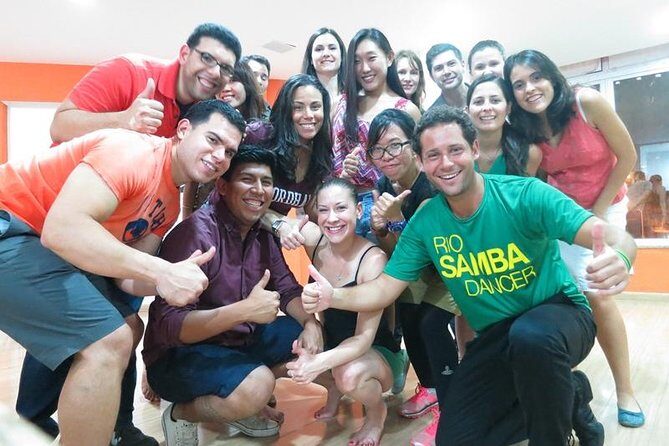
Book it if you want:
- a fun, social activity that welcomes beginners
- a quick Rio experience you can fit into a day of sightseeing
- a couple-friendly option that doesn’t require advanced dancing
- a structured lesson that focuses on steps, not just watching
You might think twice if you’re strongly sensitive to crowded spaces during peak periods. If you arrive during end-of-year or Carnival season, there’s a chance the room will feel tight. The provider has addressed this by adjusting times and spaces at those times and moving to a bigger studio for end-of-year and Carnival, but you should still plan as if visibility might not be perfect.
If you’re very language-dependent, choose a class time when a multi-lingual guide is more likely to be present. That said, even when an instructor doesn’t speak much English, the session can still work through clear demonstration and translation tools.
Final call: should you book this $35 samba class?
I’d book it if you want a straightforward way to learn samba basics in Copacabana without overthinking it. The combination of beginner-friendly instruction, social group energy, and a quick hour-long format makes it a smart use of time.
If you hate crowds, aim for a less busy time window or go in early so you can settle and focus before the room gets full. Either way, this is the kind of activity where leaving with muscle memory and a new rhythm is the real souvenir.
FAQ
FAQ
How long is the Samba Class in Copacabana?
The class lasts about 1 hour.
Do I need a dance partner or prior dance experience?
No. You do not need a partner, and you do not need prior dance experience. The class is designed for different skill levels.
What’s included in the price?
The price includes bottled water, a local guide, a professional guide, and a tour escort or host.
Where is the meeting point?
Meet at Av. Nossa Sra. de Copacabana, 807, room 603, Copacabana, Rio de Janeiro, RJ, 22050-002, Brazil.
Is transportation to and from other places included?
No. Transportation to or from attractions is not included.
Can children participate?
Children must be accompanied by an adult.
What is the cancellation policy?
You can cancel for free up to 24 hours in advance for a full refund. If you cancel less than 24 hours before the start time, the amount paid is not refunded.